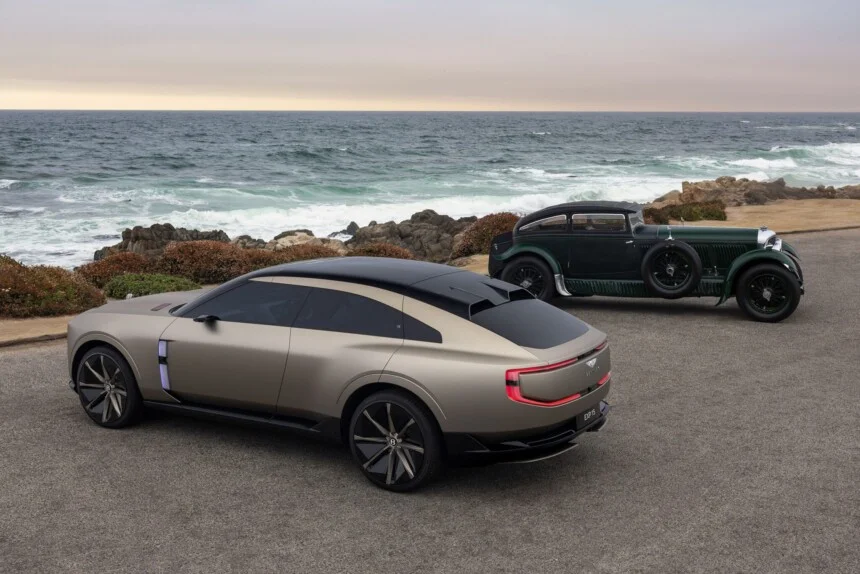
Bentley has entered the electric-vehicle market with the unveiling of the Torcal, the British luxury marque's first fully electric production car and a major test of whether wealthy customers are ready to move from powerful petrol and hybrid vehicles to battery-powered luxury. Revealed in London on September 23, the Torcal is a large luxury SUV priced from £173,000 in the UK. Bentley is using the model to introduce electric power without abandoning the styling, craftsmanship and emotional character associated with the brand. The launch also comes as premium and ultra-luxury automakers reassess how quickly their customers are willing to adopt fully electric vehicles.
The Torcal is the fourth model line in Bentley's contemporary range and the first new all-new Bentley in a decade, according to the company. Rather than creating a radically different appearance for its EV, Bentley has kept recognizable design cues from its traditional models while developing a more minimalist body. One of the most obvious examples is the illuminated "Floating Diamond Grille", which contains 76 hand-applied diamonds. An electric vehicle does not require a conventional radiator grille for engine cooling, but Bentley has retained the visual reference because the company wants the Torcal to remain immediately recognizable as a Bentley.
That approach reflects a central challenge for traditional luxury automakers: customers are not necessarily asking for a completely different luxury experience simply because the powertrain has changed. Bentley Chief Executive Frank-Steffen Walliser told Reuters that the company's intention was to make "a Bentley first." The company is therefore treating electrification as a change in propulsion technology rather than a reason to abandon the design language and sensory experience that have defined the marque for more than a century.
The Torcal's performance specifications are substantial. Bentley says the standard model uses two electric motors producing 809 bhp, or 821 PS, and 1,155 Nm of torque. It can accelerate from zero to 60 mph in 3.3 seconds and reach a maximum speed of 155 mph. The vehicle uses a 113.2 kWh battery and has an official range of up to 600 kilometres, or about 373 miles. Bentley says the battery can charge from 10% to 80% in 16 minutes under the appropriate DC charging conditions.
Bentley is also launching a performance-oriented Torcal S. The S version raises output to 876 bhp, or 888 PS, and 1,350 Nm of torque, making it the most powerful production Bentley to date, according to the company. With launch control activated, the Torcal S can accelerate from zero to 60 mph in 2.8 seconds and reach 162 mph. It retains the same 113.2 kWh battery and a claimed maximum range of 600 kilometres.
For a luxury brand, however, raw performance is only one part of the proposition. Bentley has placed heavy emphasis on the cabin, where traditional handcrafted materials are combined with new digital systems. The Torcal offers 16-way electrically adjustable front seats with heating, ventilation and massage functions. Buyers can also specify a Naim for Bentley audio system with 28 speakers and 1,780 watts of power, including Dolby Atmos 7.1.4 capability. The interior is intended to make the transition to electric propulsion feel like an evolution of Bentley luxury rather than a technological compromise.
Bentley has even addressed one of the emotional elements that disappear when a combustion engine is removed: engine sound. Instead of allowing the cabin to become completely silent, the company has developed what it calls Bentley Dynamic Symphony. The soundtrack is based on recordings of real musical instruments, including orchestral timpani, with the sound changing as the vehicle accelerates. Bentley says the system is intended to carry some of the emotional character of its historic V8 engines into the electric era. Reuters reported that the sound was designed to help "bridge the gap" for customers moving into EVs.
The strategy reflects how cautious luxury brands have become about electrification. Bentley had previously planned to become an all-electric manufacturer by 2030, but that target was abandoned as customer demand for luxury EVs proved less predictable. The company has instead extended its Beyond100+ strategy to 2035 and plans to introduce a new plug-in hybrid or battery-electric model each year for the next decade. Existing products such as the Continental GT, Continental GTC and Flying Spur are now offered exclusively with plug-in hybrid powertrains.
The Torcal's arrival therefore represents a measured step rather than a complete departure from Bentley's existing strategy. Plug-in hybrids give customers the option of driving on electric power for shorter journeys while retaining an internal-combustion engine for longer trips. Bentley has said research shows the majority of journeys made by its customers can be completed using battery power alone, suggesting that the company sees electrification as practical for daily use even among luxury buyers.
Demand is the major uncertainty. The market for ultra-luxury EVs remains relatively small and has not expanded at the pace manufacturers once expected. Rolls-Royce's Spectre is already on sale as a fully electric luxury model, while Ferrari's first EV recently entered the market and generated debate about how closely an electric car should resemble a traditional performance model. Lamborghini has delayed its first EV until later in the decade, and McLaren has said it currently has no plans for a fully electric vehicle.
That broader industry hesitation makes the Torcal an important commercial experiment. Bentley is betting that buyers who can afford cars costing hundreds of thousands of pounds will increasingly accept battery power, provided they do not have to sacrifice craftsmanship, performance, comfort or brand identity. The company is also deliberately pricing the Torcal below some of its most expensive models. At £173,000, it is Bentley's cheapest model, giving the brand a potential route to younger customers and people buying a Bentley for the first time.
The attempt to reach younger customers is significant for Bentley's long-term business model. Ultra-luxury brands depend heavily on maintaining a pipeline of wealthy customers as existing owners age and their preferences change. Walliser told Bloomberg that Bentley expects a younger clientele for the Torcal and sees higher acceptance of electric cars within its market segment. The company's argument is that a more practical SUV body style and a lower entry point can broaden its customer base without moving the brand into the mainstream luxury market.
Production location is another important part of the strategy. Bentley is building the Torcal at its historic Crewe plant in northern England, where the company has completed a £350 million investment programme to prepare for the electric era. The UK government said the investment secures around 4,000 jobs at the facility and strengthens the country's advanced-manufacturing supply chain. The project includes upgrades to the factory designed to support production of the new electric Bentley.
Bentley calls this wider transformation its "Dream Factory." The company has been redesigning parts of the Crewe operation to create a more digital, flexible and lower-emission manufacturing facility. Bentley says its manufacturing site has operated on 100% green electricity since 2017 and 100% green gas since 2019, with the wider site carbon neutral for five years. The Torcal therefore forms part of a larger industrial transition rather than being a standalone new product.
The vehicle also uses technology shared across the wider Volkswagen Group. Bloomberg reported that the Torcal shares its underpinnings with Porsche's electric Cayenne, allowing Bentley to combine group engineering resources with its own luxury design and manufacturing requirements. The use of common technology platforms has become increasingly important in the automotive industry because developing electric vehicles requires enormous investment in batteries, software, electrical architecture and safety systems.
That platform strategy is particularly relevant for Bentley because production volumes are far smaller than those of mass-market automakers. Luxury manufacturers cannot always justify developing every major component completely independently. By using group technology underneath the vehicle and differentiating it through design, materials, suspension tuning and craftsmanship, Bentley can spread development costs while preserving a distinctive customer experience.
Technology extends beyond the powertrain. Bentley says the Torcal features all-wheel drive, all-wheel steering and an advanced active suspension system called Bentley Active Ride. Each wheel uses an electrically controlled hydraulic pump connected to its own damper, allowing the system to adjust the vehicle's body control continuously. The vehicle also includes intelligent driver-assistance features and systems intended to help with parking and navigating difficult manoeuvres.
The interior also introduces a new philosophy around passenger comfort. Bentley says the Torcal can use a "Curation Engine" to adjust aspects of the cabin environment according to the selected driving mode. The system can alter seat settings, ambient lighting, audio, sunroof and heating or ventilation preferences. The idea is consistent with the brand's broader attempt to make technology work quietly in the background while preserving the feeling of personalized luxury.
Pricing will remain one of the key commercial factors. While £173,000 makes the Torcal relatively accessible by Bentley standards, it is still far above the price of mainstream electric SUVs. The customer is paying not simply for zero-emission transportation but for a handcrafted luxury product, exclusive materials, high performance and a premium ownership experience. That means Bentley must prove that affluent buyers place sufficient value on the complete package to justify the price when alternative luxury EVs from established and new manufacturers are becoming more numerous.
The company's cautious approach reflects lessons from the wider EV market. Luxury buyers may have been early adopters of new technology, but they are also unusually sensitive to design, brand heritage, driving feel and convenience. Charging infrastructure, long-distance usability and the emotional response to electric propulsion can matter as much as battery capacity. Bentley's decision to combine a 375-mile range, rapid charging and a synthetic orchestral soundtrack shows that it is addressing both practical and emotional concerns.
The Torcal's launch also comes at a moment when the global automotive market is becoming more fragmented. Some manufacturers are accelerating toward battery-electric vehicles, while others are increasing hybrid offerings because customer adoption is progressing unevenly across regions and market segments. Reuters has highlighted how automakers are increasingly focusing on flexibility, scale and profitability as the EV transition evolves. Bentley's strategy fits into that broader shift toward a mixed powertrain future rather than an immediate universal move to battery-only vehicles.
For investors and the broader Volkswagen Group, the Torcal is consequently more than a brand showcase. It is a test of whether Bentley can grow while making the expensive transition to electric vehicles without damaging margins or the exclusivity that supports its pricing. Bloomberg reported that Bentley is targeting double-digit returns on sales while acknowledging the automotive industry's financial pressures. The company has said the Torcal's development cost more than £1 billion, highlighting the scale of the investment required to create a new luxury EV.
The first customer deliveries are expected in spring 2027, giving Bentley several months to build production and collect orders. The company will then have a clearer indication of how many existing Bentley owners are prepared to switch to electric power and how many new customers the Torcal can attract. The response will help determine how quickly Bentley can expand its future electric portfolio and how much further it can shift away from combustion engines.
The Torcal arrives with a clear message from Bentley: electric propulsion does not have to mean abandoning the character of a luxury car. The company has retained familiar design elements, added a powerful dual-motor system, developed a bespoke cabin and created a soundscape intended to evoke the brand's combustion-engine history. At the same time, the vehicle introduces technology and manufacturing changes that are designed to prepare Bentley for a different automotive market.
Whether wealthy customers agree with that formula will determine the Torcal's commercial significance. Bentley has entered the EV market at a cautious moment, when several luxury manufacturers are reassessing their plans because demand has not developed uniformly. Its answer is not to retreat from electrification, but to proceed on its own terms.
For now, the Torcal represents a carefully calibrated transition: a fully electric SUV with supercar-like acceleration, a long driving range and traditional Bentley craftsmanship, introduced at the lower end of the marque's price spectrum. The real test begins when customers start taking delivery in 2027 and the company discovers whether its historic buyers are ready to make the move from the roar of a V8 to an electric motor accompanied by the sound of timpani.
**What to Watch Next:**
The main indicators will be Torcal order volumes, the mix of new customers versus existing Bentley owners and the timing of first deliveries in spring 2027. Investors will also watch Bentley's future model launches under its Beyond100+ strategy, the performance of the Crewe manufacturing programme and whether demand for luxury EVs strengthens enough for the company to accelerate its electric portfolio.