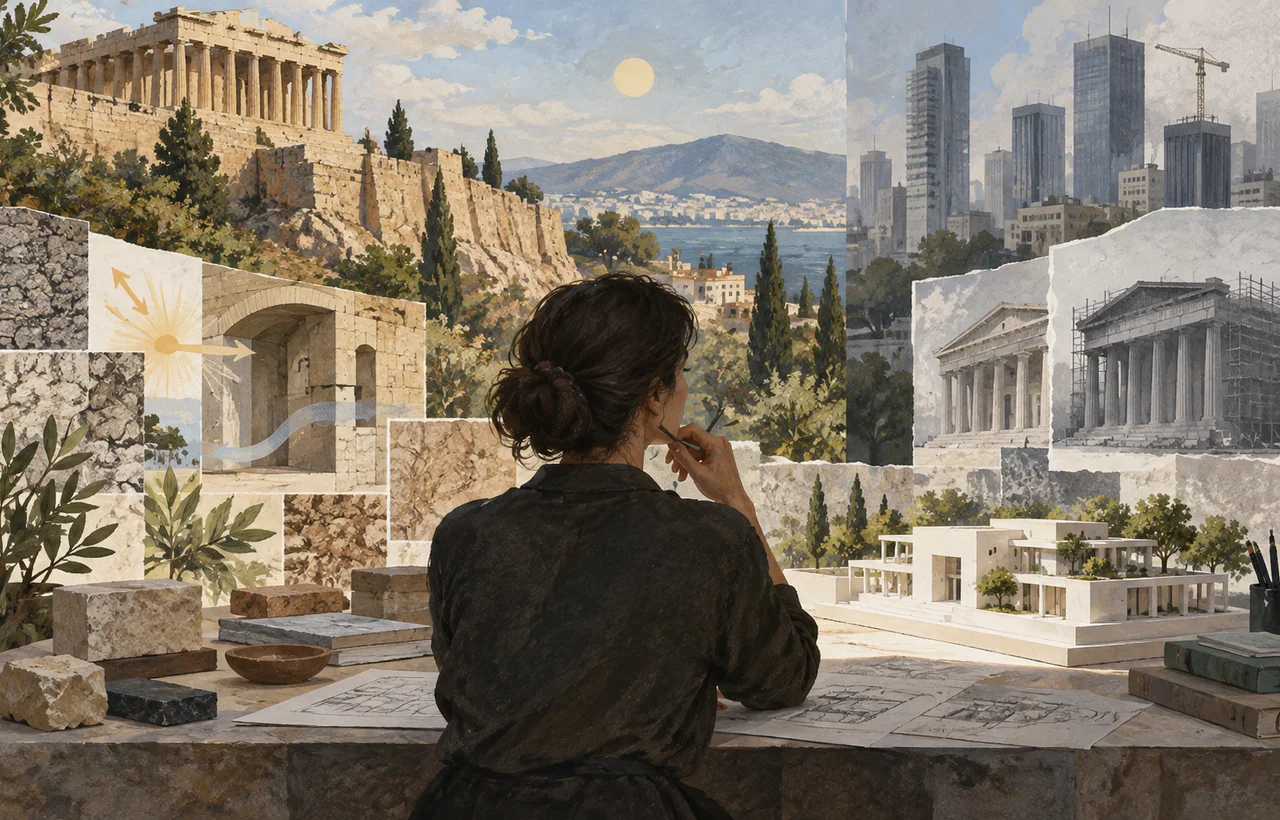
Ancient buildings are useful to modern designers when they are studied as responses to climate, materials, labour and public life—not treated as a catalogue of decorative forms.
Start with performance
Courtyards, thick walls, shaded openings and carefully oriented streets often moderated heat before mechanical cooling. Their value lies in how geometry, mass and air movement worked together under local conditions.
Those strategies cannot simply be copied into any climate. A solution shaped by dry heat may fail in a humid region, and a material that once came from a nearby quarry may now carry a very different environmental cost.
Structure and symbolism are connected
Arches, domes and columns solved engineering problems, but they also communicated religion, government and social hierarchy. Reusing the form without its history can turn a complex reference into surface decoration.
A stronger design explains why a precedent matters: perhaps it creates a durable public room, makes construction legible or uses repetition to organise movement. The reference should improve the building, not merely make it look established.
Use history as evidence, not authority
Historic buildings that survive are a selective sample. Many ordinary or poorly built structures disappeared, and some celebrated monuments depended on coercive labour or resource systems that should not be romanticised.
The practical lesson is to test old ideas against present needs, codes and climate data. History expands the designer's toolkit; it does not remove the obligation to measure performance today.