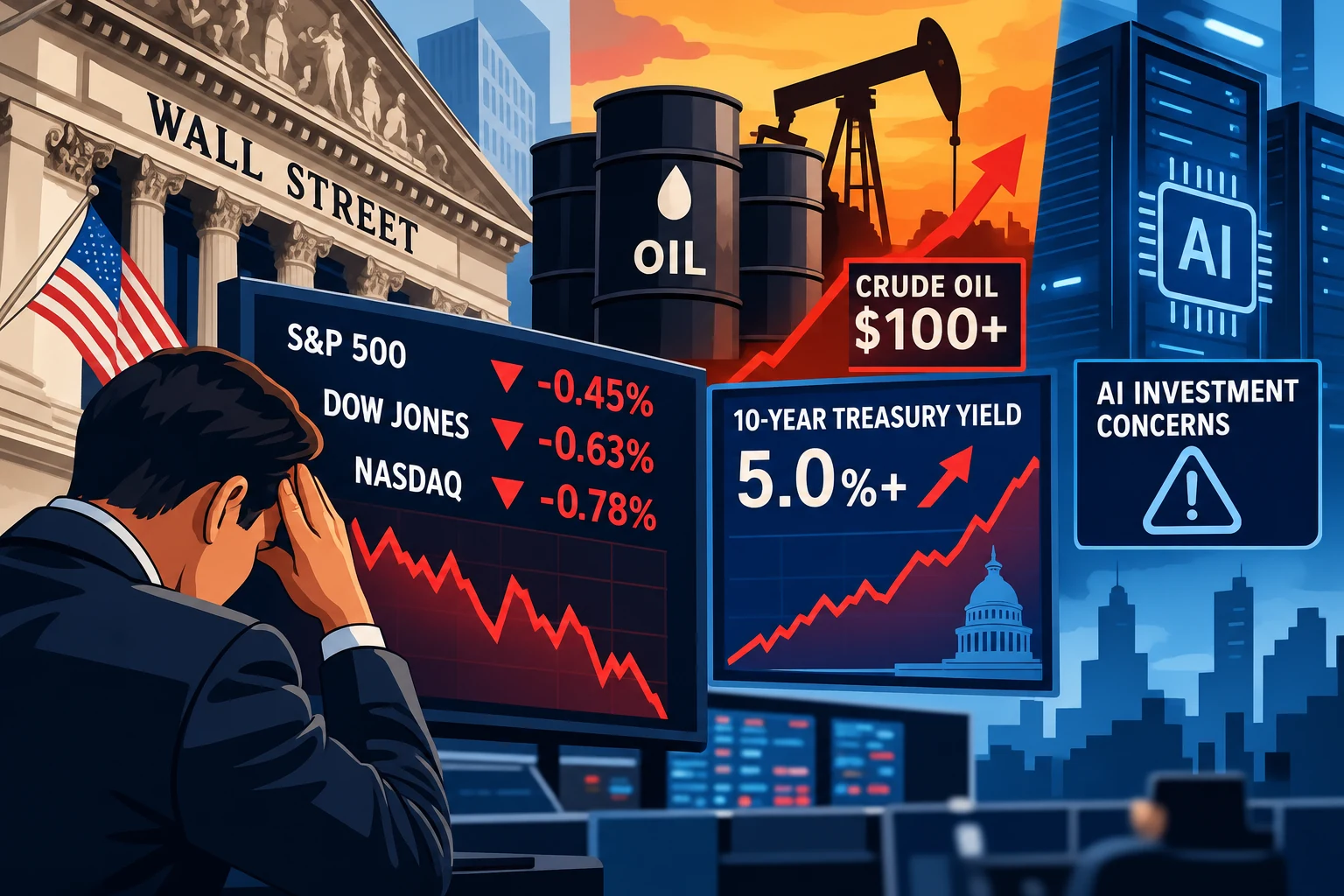
US stock futures came under pressure on Tuesday, September 15, as investors faced a combination of sharply higher oil prices, rising Treasury yields and growing questions about the pace of artificial-intelligence investment. Major US indexes were heading toward another lower open after Wall Street extended its recent losses, with markets increasingly worried that an energy-driven inflation shock could force the Federal Reserve to keep interest rates higher for longer. The pressure came at an especially sensitive time, with the Fed preparing to announce its latest policy decision and traders assigning a 94.5% probability to a quarter-point rate increase.
The sell-off reflected several different concerns arriving at once. Crude oil prices surged as the continuing Middle East conflict disrupted energy infrastructure and raised the risk of prolonged supply shortages. At the same time, the benchmark 10-year US Treasury yield moved above 5%, reaching its highest level since 2007. Higher borrowing costs can pressure businesses, consumers and financial markets, while expensive oil adds a separate inflationary burden. The combination has made investors more reluctant to increase exposure to equities after a period of strong market gains.
The major US indexes ultimately closed lower that day. The Dow Jones Industrial Average fell 328.09 points, or 0.63%, to 52,093.11. The S&P 500 declined 34.25 points, or 0.45%, to 7,585.73, while the Nasdaq Composite dropped 204.84 points, or 0.78%, to 25,981.57. The decline was broad, with consumer-discretionary stocks among the weakest sectors, while energy shares advanced as companies benefited from higher crude prices.
Oil was the most immediate source of concern. Front-month West Texas Intermediate futures settled 4.4% higher, while Brent crude gained 2.9%. Diesel futures also reached a record high. The latest price increases followed fresh attacks on Saudi Arabia's energy infrastructure, increasing fears that the disruption could remove more oil from the international market. For investors, the concern is not simply the price of crude itself but the potential economic consequences if elevated energy costs persist for weeks or months.
Oil affects almost every part of the economy. Higher fuel costs directly raise expenses for airlines, trucking companies, shipping operators and manufacturers. They also increase the cost of producing and transporting food and consumer products. If companies pass those costs on to customers, a temporary energy shock can develop into broader inflation. That possibility has become especially important for markets because the Federal Reserve is already preparing to raise interest rates in response to persistent price pressures.
The Treasury market is sending an equally important signal. The 10-year Treasury yield breached 5% for the first time since 2007, reflecting a combination of inflation worries, expectations for tighter monetary policy and concerns about government borrowing. The move matters for equities because Treasury yields are used as a benchmark for pricing a wide range of financial assets. As yields rise, investors can demand greater returns from stocks to justify taking on additional risk.
Higher yields are particularly significant for technology and growth companies. Many of these businesses are valued partly on expectations of profits far into the future. When interest rates increase, the present value of those future earnings becomes less attractive. That can put pressure on high-growth stocks even when the underlying businesses continue to expand. AI-related companies face an additional challenge because their valuations have risen alongside enormous expectations for future demand and infrastructure spending.
The AI debate has become another source of market uncertainty. Semiconductor stocks, which have played a major role in driving US equities higher this year, had already suffered a sharp sell-off after executives and technology leaders raised concerns about the potential risks of rapid AI development. Growing opposition to data-centre construction has added to the pressure, with communities and policymakers increasingly questioning the amount of electricity and infrastructure required for large AI facilities.
Investors are therefore beginning to separate companies that directly benefit from continued AI infrastructure spending from those that could face disruption if the pace of development changes. Semiconductor manufacturers and data-centre suppliers are heavily dependent on continued capital expenditure by cloud companies and AI developers. Established software businesses may face a different set of risks and opportunities as AI changes the competitive landscape. That distinction contributed to the uneven performance across technology shares during the latest market decline.
The Philadelphia Semiconductor Index was unable to recover fully from the previous day's sell-off, gaining only about 0.4% during Tuesday's session. The limited rebound indicated that investors remained cautious toward chipmakers even as the wider technology sector attempted to stabilize. Nvidia and other major semiconductor stocks have become particularly sensitive to changes in expectations because of their central role in the AI investment cycle.
The Federal Reserve's upcoming decision became the main focal point. Markets had moved rapidly toward expecting a rate increase after stronger inflation data and the jump in crude prices. The probability of a 25-basis-point hike had risen to 94.5%, compared with only 33.1% one month earlier. The move would mark the first US rate increase in more than three years.
The critical question, however, was whether September's expected increase would be a one-time adjustment or the beginning of a broader tightening cycle. Markets were increasingly concerned that persistent energy inflation could force the Fed to raise rates again. Investors were therefore paying close attention not just to the policy rate but also to Fed Chair Kevin Warsh's comments and the central bank's updated economic projections. Any indication of additional increases could put further pressure on bonds and stocks.
The unusual feature of the current environment is that the inflation pressure is partly coming from outside the US economy. The conflict in the Middle East is reducing energy supplies and raising transportation costs, rather than simply reflecting excessive domestic demand. That creates a difficult problem for monetary policymakers. Higher interest rates can slow spending and investment, but they cannot produce more crude oil or repair damaged infrastructure. The Fed must therefore determine whether the energy shock is likely to remain temporary or become embedded in broader inflation expectations.
The market is already seeing signs that fuel inflation is spreading. Diesel prices reached record levels, while higher wholesale prices have added to concerns about transportation costs. Companies that operate large vehicle fleets or depend on energy-intensive manufacturing may face significant margin pressure. If those businesses respond by raising prices, inflation could remain above the Fed's target even if other areas of the economy begin to cool.
US government borrowing is another concern. Rising long-term yields reflect not only monetary-policy expectations but also investor concerns about the supply of Treasury securities and the fiscal outlook. Higher borrowing costs can increase government interest expenses and raise financing costs for businesses. Treasury Secretary Scott Bessent has argued that recent moves in bond yields are driven partly by global factors, including oil prices and expectations surrounding the Federal Reserve, rather than exclusively by US fiscal policy.
The rise in yields also changes the competitive landscape for investors. Government bonds provide a relatively predictable source of income, so as yields rise, investors may become less willing to pay high valuations for stocks. This dynamic is particularly important when equity indexes are trading near elevated levels. The S&P 500 had already experienced strong gains during 2026, increasing the sensitivity of the market to changes in the interest-rate outlook.
Energy stocks have been the notable exception. Higher crude prices can increase revenue and cash flow for producers, creating a natural hedge against an oil-driven market downturn. Energy was the only major S&P 500 sector to record a meaningful gain during Tuesday's session, rising 2.3%. The divergence highlights how commodity shocks can create significant differences between industries even when the overall stock market is falling.
Consumer companies are facing the opposite environment. Higher gasoline and diesel prices reduce the amount of money households can spend on discretionary products and services. Transportation costs can also increase the price of goods delivered to stores. Consumer-discretionary stocks were therefore among the weakest areas of the market during the latest decline, reflecting fears that sustained fuel inflation could eventually weaken demand.
Cryptocurrency-related stocks were also under pressure. Bitcoin weakened at the same time that the US Senate failed to advance comprehensive cryptocurrency legislation, adding a policy-related source of uncertainty to an already volatile asset class. Coinbase shares fell around 10.1%, while Strategy declined about 5.4%. The move demonstrated that the market's risk-off mood was affecting digital assets as well as traditional equities.
The market breadth reinforced the defensive tone. On the New York Stock Exchange, declining issues outnumbered advancing shares by about 2.56 to 1. On the Nasdaq, the ratio was roughly 2.33 to 1. There were significantly more new lows than new highs on both exchanges. Such breadth data can provide a broader picture of market sentiment because they show that selling pressure extends beyond a handful of large companies.
At the same time, the sell-off came after a period in which US equities had remained relatively resilient despite geopolitical uncertainty. The challenge for investors was deciding whether the latest decline represented another temporary pullback or the beginning of a more durable repricing. The answer depended heavily on oil prices and the Federal Reserve's response. If energy prices stabilized, inflation expectations could ease and Treasury yields could retreat. If oil continued climbing, markets could begin pricing a significantly longer period of restrictive policy.
The AI investment cycle added a different kind of uncertainty. Companies have committed enormous sums toward data centres, semiconductors and power infrastructure, with expectations of continued growth in AI demand. A slowdown in AI development or greater regulatory scrutiny could affect that spending. The technology sector therefore faces both macroeconomic pressure from higher interest rates and industry-specific concerns about the pace and economics of AI expansion.
Still, the long-term AI story has not disappeared. The underlying demand for computing capacity remains substantial, and major technology companies continue to invest heavily in AI models and infrastructure. The market debate is increasingly about valuation and returns rather than whether AI has a future. Investors want to know whether the enormous capital being deployed today will generate enough revenue and productivity gains to justify the cost.
That question is especially important for semiconductor companies. Their earnings depend heavily on continued orders from cloud providers and AI developers, while their valuations already reflect strong expectations for future growth. If rates remain elevated, the cost of financing data-centre projects increases. If AI demand remains strong, however, chip demand can continue to support earnings. The sector is therefore positioned at the intersection of the two major themes currently moving the market.
The Federal Reserve's policy decision ultimately became the most immediate catalyst. Investors were expecting the first rate hike since 2023, but the market's focus extended well beyond the announcement itself. Fed projections, the voting split among policymakers and guidance from Chair Warsh were all likely to determine whether stocks and bonds continued their decline or stabilized.
The oil market remained just as important. As long as crude prices stayed elevated because of the Middle East conflict, inflation expectations could remain difficult to control. A sustained disruption to global energy infrastructure would raise the possibility of further rate increases, higher bond yields and weaker consumer demand. Conversely, improvements in shipping or additional production could reduce some of the pressure relatively quickly.
For investors, the latest Wall Street decline demonstrates how several seemingly separate risks can reinforce one another. Higher oil raises inflation, inflation pushes rate expectations higher, higher rates lift Treasury yields, and rising yields put pressure on growth stocks. At the same time, uncertainty over AI spending adds another reason for investors to reassess expensive technology shares. The resulting environment is much more complicated than a conventional stock-market pullback.
The most important question is whether these pressures remain temporary. If the Middle East conflict eases and oil prices fall, the Federal Reserve may have less reason to continue tightening aggressively. A decline in yields could then support technology stocks and broader equity valuations. But if energy disruptions persist, the market may have to adjust to a world of higher inflation and interest rates for longer.
That is why the direction of crude oil and Treasury yields has become almost as important as individual corporate earnings. Investors are watching the economy through two market indicators that are responding directly to geopolitical developments and monetary policy. The relationship between the three — oil, bonds and stocks — is likely to remain a defining feature of the market until the inflation outlook becomes clearer.
**What to Watch Next:**
Investors will monitor Federal Reserve guidance, Treasury yields, crude oil prices and developments in the Middle East. The next important question is whether the expected September rate hike is followed by further increases later in 2026. In technology, Nvidia and other semiconductor stocks will remain closely watched as investors assess whether AI spending can continue at its current pace despite higher financing costs and growing scrutiny.