
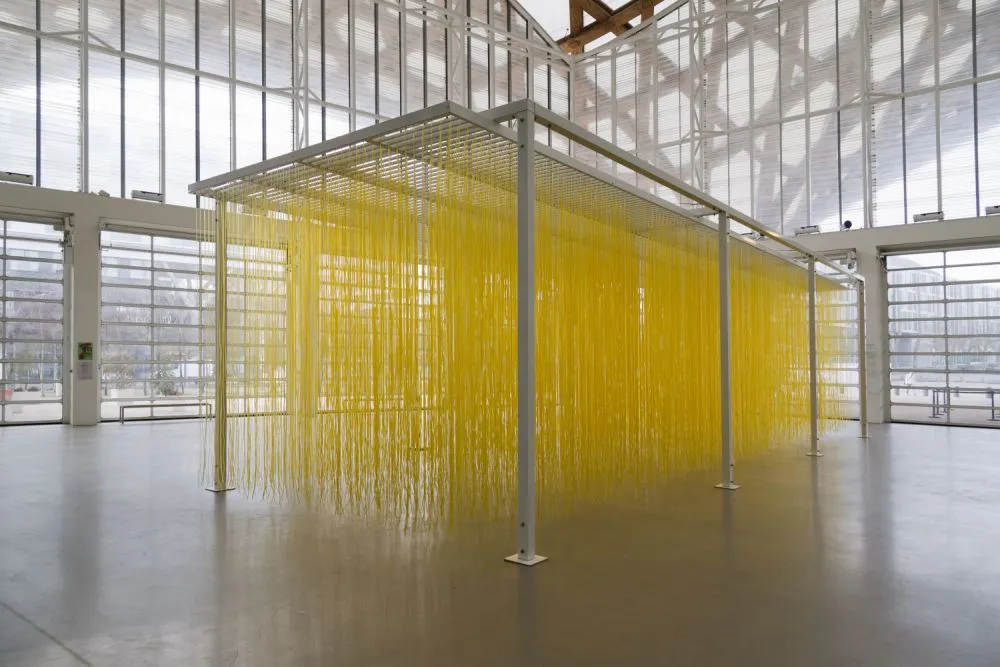
A striking yellow sculpture by Venezuelan kinetic-art pioneer Jesús Rafael Soto is currently transforming the landscape around London's Serpentine South in Kensington Gardens, inviting members of the public to physically enter the artwork rather than simply view it. Titled *Pénétrable BBL Jaune*, the installation opened on June 16, 2026, and will remain on public display through October 25. Serpentine says the work is free to visit and represents the first outdoor presentation of Soto's work in the United Kingdom. The exhibition forms part of the institution's 2026 public-art programme, extending its activity beyond the gallery walls and into Kensington Gardens.
The installation is immediately recognizable because of its intense yellow colour and unusual structure. Measuring 10 metres long, *Pénétrable BBL Jaune* consists of approximately 4,000 suspended yellow PVC tubes attached to a steel framework. From outside, the closely positioned strands create a dense field of yellow that seems to shimmer and shift. Once visitors enter, however, the sculpture becomes a different experience. The tubes move as people walk through them, creating constantly changing patterns of colour, light and space. The effect is partly produced by a moiré phenomenon, in which overlapping lines create the visual impression of movement and vibration.
What makes the public presentation particularly notable is that visitors are not expected to maintain a distance from the sculpture. They are encouraged to walk through it, allowing their movements to activate the work. Soto's *Pénétrable* series was based on precisely this idea: the viewer is not a passive observer but a participant whose physical presence completes the artwork. Serpentine describes the sculpture as an environment in which movement, space and tactility become part of the artistic experience.
Soto, who was born in Ciudad Bolívar, Venezuela, in 1923 and died in Paris in 2005, was one of the pioneers of kinetic art. His career focused heavily on the relationship between movement and perception, using materials such as metal, nylon, Perspex and industrial paint to challenge the conventional boundaries between painting and sculpture. After moving to Paris in 1950, Soto became part of an international artistic community experimenting with motion and abstraction. He participated in the influential 1955 exhibition *Le Mouvement* at Galerie Denise René alongside artists including Alexander Calder, Marcel Duchamp and Victor Vasarely.
The *Pénétrable* works became one of the defining achievements of Soto's career. He created his first example in 1967 and produced more than 70 versions over the following decades, varying their colours, dimensions and materials. The central principle remained consistent: space itself could become an artwork, and the visitor's movement through that space could alter its appearance. Rather than presenting a fixed sculpture with one intended viewing angle, Soto created structures whose visual identity changes continuously depending on where the observer stands and how they move.
The current London work has a particularly interesting history. The original *Pénétrable BBL Jaune* was made in 1999, while the edition currently being exhibited was produced in 2023. The new edition was part of the continuation of Soto's work by his estate and coincided with the centenary celebrations surrounding his birth. Serpentine identifies the London presentation as *Pénétrable BBL Jaune (1999; 2023 Edition)*, connecting the present-day installation directly to the artist's original concept.
Its location is equally important. Instead of being placed inside a conventional gallery, the sculpture occupies a public setting in Kensington Gardens near Serpentine South. Trees, paths, daylight and visitors become part of the visual environment. People can encounter the installation while walking through the park or visiting the Serpentine, making it accessible to audiences who may not normally seek out contemporary art. The outdoor setting also means that the sculpture is experienced under changing conditions throughout the day.
The presentation is part of Serpentine's continuing effort to use the surrounding park as an extension of its exhibition programme. The institution's public-art programme has increasingly placed major sculptures and installations into Kensington Gardens, allowing artworks to interact directly with the landscape and the public. Soto's piece is especially well suited to this approach because its meaning depends on the movement of visitors.
The response to the installation has reflected its interactive nature. Time Out described the work as a massive interactive yellow sculpture, noting that visitors can walk or even run through its strands. That physical accessibility distinguishes it from many conventional public artworks, where touching or entering the work is prohibited. In Soto's case, movement through the sculpture is not merely allowed; it is fundamental to the concept.
The simplicity of the materials is another important aspect of the installation. Thousands of narrow tubes are individually uncomplicated, but their repetition creates a large-scale environment with a surprisingly complex visual effect. When visitors move through the strands, the lines overlap and separate, producing constantly changing images. From a distance, the sculpture can appear almost solid; from inside, it becomes transparent, fragmented and animated. This contrast is one of the reasons Soto's *Pénétrable* works remain visually powerful decades after they were first developed.
The sculpture also offers a different way of thinking about immersive art. Contemporary immersive installations often depend on digital projections, sensors, artificial intelligence or virtual-reality technologies. Soto achieved a comparable sense of participation using physical materials and human movement. There is no computer-generated world that responds to the viewer. Instead, the visitor's body provides the movement that changes the work. The result is an immersive environment created through a relatively simple physical mechanism.
That distinction has helped keep Soto's work relevant to contemporary art discussions. His installations anticipated questions that now appear frequently in digital media: how an audience interacts with an environment, how movement changes perception and how the viewer can become part of the artwork itself. The Serpentine presentation gives visitors an opportunity to experience those ideas directly rather than encountering them only through historical documentation.
The public exhibition also places Soto's work within a particularly active cultural season at Serpentine. The 2026 programme includes the 25th Serpentine Pavilion, designed by Mexico City-based LANZA atelier, alongside exhibitions and performances across the galleries. The temporary pavilion and Soto's sculpture are both scheduled to remain through October 25, creating a concentrated period of architectural and artistic activity in Kensington Gardens.
The Soto installation also featured during Serpentine's Summer Party in June, when guests experienced highlights from the institution's programme across Kensington Gardens. The event included the pavilion and the Soto sculpture, bringing the artwork into a wider programme involving figures from the worlds of art, architecture, fashion, business and technology.
For visitors, the sculpture's strongest feature may simply be that no two experiences are identical. A person standing outside sees a bright yellow geometric structure. Someone entering slowly experiences strands brushing past their body. A group moving together creates a different pattern of motion, while someone observing from a distance sees the entire structure shifting as people move inside. The artwork therefore changes continuously without needing a motorized performance.
That quality also changes the role of photography. Images of *Pénétrable BBL Jaune* often capture the installation from outside, showing the dense yellow strands as a striking geometric form. But photographs cannot fully reproduce the experience of moving through it. The work's physical and tactile qualities are essential, making the public exhibition something that must be experienced directly rather than simply viewed online.
Soto's artistic philosophy is particularly evident in that difference between seeing and experiencing. He was interested in the idea that perception is not fixed and that space can be understood differently depending on movement. The *Pénétrable* series converts that idea into something physical: the visitor's body becomes the instrument through which the work is activated.
The installation also demonstrates the value of placing historic works in contemporary public spaces. Although Soto developed his first *Pénétrable* nearly 60 years ago, the concept does not feel disconnected from today's interest in interactive and participatory experiences. Visitors accustomed to responsive digital environments can encounter a much earlier form of interaction that depends entirely on physical space.
For London's art community, the exhibition provides another opportunity to reassess Soto's position in international art history. His work is held in major collections including Tate, MoMA, the Centre Pompidou, Museum Ludwig and the Guggenheim, while major retrospectives have been presented by institutions such as the Guggenheim Museum in New York and Guggenheim Bilbao.
The London presentation is therefore not simply a temporary decoration in Kensington Gardens. It brings the work of an important 20th-century artist into direct contact with a broad contemporary audience and demonstrates how his ideas about perception and participation continue to function outside a traditional museum context.
There is also an accessibility dimension to the exhibition. Because the sculpture is free to visit and situated in a public park, people can encounter it without purchasing a museum ticket or booking a conventional gallery visit. Serpentine's decision to present the work outdoors allows families, tourists, local residents, art students and casual park visitors to experience the same installation.
The presentation's temporary nature adds another layer of interest. The sculpture is scheduled to disappear from the park on October 25, meaning that its physical presence in Kensington Gardens is limited to a few months. This temporary quality is shared with the Serpentine Pavilion, which also closes on the same date. The disappearance of both structures will significantly change the appearance of the area as autumn progresses.
Until then, *Pénétrable BBL Jaune* remains one of the most distinctive public artworks currently on display in London. Its bright yellow strands create a visual landmark, but its significance goes beyond appearance. The installation turns movement into part of the composition and makes the visitor responsible for activating the experience.
More than two decades after the original work was created and more than 20 years after Soto's death, the sculpture demonstrates the continuing strength of his central artistic idea. The work does not simply represent movement; it produces an environment in which movement, perception and participation become inseparable.
For anyone visiting Kensington Gardens before October 25, the experience is direct: approach the yellow structure, step inside and allow the strands to move around you. In doing so, visitors become part of a work that Soto designed to exist through interaction. That may be the most important reason the installation feels as contemporary today as it did when the *Pénétrable* series first emerged.
**What to Watch Next:**
*Pénétrable BBL Jaune* remains free and on public display at Serpentine South in Kensington Gardens until October 25, 2026. The same date marks the scheduled closing of the 2026 Serpentine Pavilion. Serpentine's autumn programme will then introduce new exhibitions and projects, including Justin Caguiat's *Change Ringing*, opening October 8 and continuing into January 2027.