
Serpentine Galleries is entering the final months of 2026 with one of the organisation’s broadest programmes in recent years, combining contemporary exhibitions, public sculpture, experimental architecture, live performance and research into the future relationship between art and technology. Based in Kensington Gardens, London, Serpentine operates two galleries — Serpentine North and Serpentine South — and has increasingly used the surrounding park as an extension of its artistic programme. In September, the organisation opened a major solo exhibition by New Delhi-based artist and filmmaker Amar Kanwar, while its 25th Serpentine Pavilion and Jesús Rafael Soto’s immersive *Pénétrable BBL Jaune* remain on view until October 25. At the same time, Serpentine is developing longer-term projects focused on emerging artistic and technological ecosystems.
The latest major exhibition at the organisation is Amar Kanwar’s presentation, which opened on September 23 at Serpentine North and runs through January 31, 2027. Serpentine describes Kanwar as one of the most prominent artists working in moving image today. The exhibition combines new and existing films in a site-specific installation designed to transform the gallery into a meditative visual and sonic environment. His practice frequently examines themes including displacement, nationalism, violence, power, censorship and memory, while connecting specific historical and political experiences to broader questions about society and identity. The exhibition continues Serpentine’s 2026 emphasis on artists whose work expands conventional ideas about media and audience experience.
The Kanwar exhibition follows an active first half of the year for Serpentine. David Hockney’s major presentation ran at Serpentine North from March 12 to August 23, featuring recent and new works, while Cecily Brown’s *Picture Making* presented a major body of work at Serpentine South. The organisation has positioned the 2026 programme around intergenerational artists whose practices engage with changing technologies and new ways of connecting artists with audiences. Serpentine says its position within the Royal Parks allows it to bring art into everyday life, making the surrounding environment an important part of its cultural strategy.
One of the strongest examples of that strategy is Jesús Rafael Soto’s *Pénétrable BBL Jaune*, a large public sculpture installed near Serpentine South in Kensington Gardens. On view from June 16 to October 25, the work is made from approximately 4,000 suspended yellow PVC tubes within a steel structure. Visitors can enter the sculpture and move through the strands, causing them to shift and creating changing visual patterns. Serpentine identifies the work as the first outdoor presentation of Soto’s art in the United Kingdom and says the installation reflects the Venezuelan artist’s lifelong interest in movement, space and tactility.
The Soto presentation is important to Serpentine because it demonstrates how the organisation is redefining the boundary between gallery and park. Rather than asking visitors to enter a conventional exhibition space, the installation places a major artwork directly within a public landscape. That model is central to the institution’s wider identity and allows audiences to encounter contemporary art while walking through Kensington Gardens. The organisation describes art situated in the park as a central part of its year-round activities, extending exhibitions and artistic projects beyond the gallery buildings.
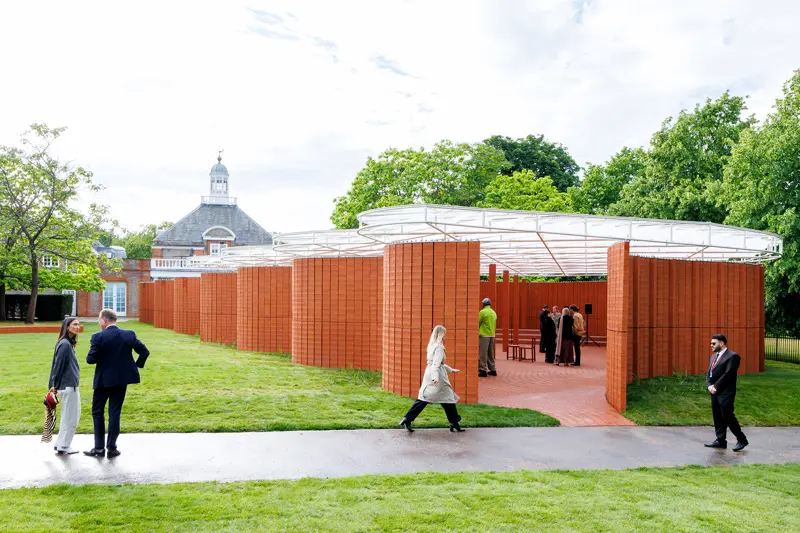
Architecture is playing an equally important role in the 2026 programme. This year marks the 25th Serpentine Pavilion, with Mexico City-based LANZA atelier, founded by Isabel Abascal and Alessandro Arienzo, selected to create the temporary structure. Called *a serpentine*, the Pavilion opened on June 6 and will remain in Kensington Gardens until October 25. Its design takes inspiration from the English crinkle-crankle wall, using a curving form that gains structural stability from its shape. Serpentine says the design also makes a subtle reference to the nearby Serpentine Lake.
The anniversary is significant because the Serpentine Pavilion programme has become one of the organisation’s best-known architectural initiatives. Since its beginning, it has invited architects who had not previously built in the United Kingdom to create temporary structures next to the gallery. The 2026 project marks the 25th commission, linking the current programme with the initiative’s history and its original association with the work of Zaha Hadid. The Pavilion is not simply a design exhibition; it functions as an active venue for talks, performances and public events throughout the summer and autumn.
That live programme continues through Park Nights 2026, Serpentine’s annual series of interdisciplinary performances staged inside the Pavilion. Since 2002, Park Nights has brought together art, music, film, theatre, dance, literature, philosophy, fashion and technology. This year’s programme has included performances by Sophia Stel and Chanel Beads, while September and October feature events by Ebun Sodipo and Rosa-Johan Uddoh, followed by Shala Miller. The format reinforces Serpentine’s role not only as an exhibition venue but also as a platform for new forms of live and interdisciplinary work.
Technology and research are becoming an increasingly visible part of the organisation’s identity as well. On September 2, Serpentine announced the launch of the Future Art Ecosystems R&D Fellowship, a programme focused on exploring how artistic practices can evolve alongside changing technological, social and institutional conditions. The initiative extends Serpentine’s research-oriented work beyond traditional exhibitions and reflects its interest in how future cultural systems might be built.
The fellowship sits within a broader organisational interest in research and advanced technologies. In July, Serpentine announced *Processing... Art and Advanced Technologies*, transforming its Education Space into an active archive, listening room and research environment. The project explores the relationship between art, technology and new forms of practice. Such programmes indicate that Serpentine increasingly sees research not as something separate from exhibitions but as a core part of how the organisation engages with artists and audiences.
Ecology is another major focus. In July, Serpentine announced Formafantasma as its Lead R&D Fellows, Ecology, beginning a multi-year collaboration. The partnership reflects a growing emphasis on environmental questions and the relationship between artistic production and ecological systems. For an institution embedded within Kensington Gardens, that focus has an especially direct relevance: the surrounding park is not just a backdrop for exhibitions but also an environment with its own ecological, architectural and public dimensions.
This combination of art, technology and ecology represents an important shift in the organisation’s long-term direction. Serpentine’s programme has traditionally been associated with contemporary exhibitions and the annual Pavilion, but its recent announcements show a more expansive model. Research fellowships, technology projects, public art and ecological collaborations allow the institution to work with artists and ideas over longer periods rather than limiting its activity to the opening and closing dates of exhibitions.
The organisation’s location gives it unusual opportunities to pursue that model. Serpentine South and Serpentine North sit a short distance apart on either side of the Serpentine Bridge inside Kensington Gardens. Both galleries are free to enter, and Serpentine describes itself as free and open to all. The combination of free exhibitions and a high-profile public-park setting allows the organisation to reach audiences who might not ordinarily visit a contemporary-art institution.
Serpentine’s relationship with Kensington Gardens also helps distinguish it from many other London galleries. Its projects operate within a Royal Park rather than a conventional museum district, allowing architecture and sculpture to interact directly with nature and public life. The 2026 Pavilion and Soto installation are good examples: one transforms a temporary architectural structure into a venue for performance and discussion, while the other turns a large public sculpture into an interactive environment.
The organisation’s programme also demonstrates a deliberate interest in different generations and artistic disciplines. Hockney and Brown represented major established figures in 2026, while Kanwar’s exhibition focuses on moving image and installation, and Soto’s outdoor sculpture introduces a significant historical figure in kinetic art to a new public setting. The combination enables Serpentine to present very different artistic practices while maintaining a common emphasis on experimentation, audience engagement and new approaches to space.
Serpentine’s public-facing model is also visible in its events calendar. Alongside exhibitions and the Pavilion, the organisation hosts talks, performances and artist conversations. On September 23, for example, Amar Kanwar appeared in conversation with Sherna Dastur and Artistic Director Hans Ulrich Obrist. The event accompanied the opening of Kanwar’s exhibition and demonstrates how Serpentine uses discussion and interpretation to deepen its exhibition programme.
The final weeks of the 2026 Pavilion season are likely to remain busy. The Pavilion is scheduled to operate through October 25, with altered opening hours on selected September and October dates because of events. The organisation’s Park Nights series continues through early October, while the Soto sculpture remains on display nearby. The concentration of architecture, public art and performance in the same park creates a temporary cultural district in which visitors can experience several different Serpentine projects during a single visit.
The next exhibition transition is already approaching. Justin Caguiat’s *Change Ringing*, described by Serpentine as the artist’s first UK institutional exhibition, opens at Serpentine South on October 8 and runs through January 10, 2027. The show will include painting, sculpture, printmaking, sound and film in a site-responsive installation. Its arrival means the organisation’s programme will continue evolving even as the temporary Pavilion and Soto sculpture approach their scheduled October 25 closing date.
From an organisational perspective, the significance of 2026 lies in the range of activity rather than any single exhibition. Serpentine is simultaneously operating as a contemporary-art museum, public-art commissioner, architecture platform, live-performance venue and research organisation. Its programme crosses traditional categories, placing historic kinetic art beside experimental architecture, moving-image installations beside ecological research and contemporary exhibitions beside technology-focused initiatives.
That model also reflects changes taking place across the wider cultural sector. Art institutions are increasingly being asked to engage with technology, environmental issues and new forms of audience participation, while maintaining a clear role as places for artistic discovery. Serpentine’s current programme shows one way of responding to those pressures: maintaining a strong exhibition schedule while investing in long-term research and using public space as a central part of its identity.
The organisation’s growing research activity could become particularly important in the coming years. The Future Art Ecosystems fellowship and advanced-technology programmes suggest that Serpentine wants to participate in discussions about how artists will work in an increasingly technological environment, rather than simply exhibiting the finished products of that evolution. Its ecology fellowship similarly indicates an interest in influencing artistic and institutional practice around environmental questions.
For audiences, the immediate attraction remains the opportunity to encounter ambitious projects for free in and around Kensington Gardens. For artists, Serpentine offers several different channels — exhibitions, public sculpture, architecture, performance and research — through which ideas can develop. For London’s cultural landscape, the organisation provides a connection between established contemporary art institutions and the much broader public environment of one of the city’s major parks.
As September 2026 draws to a close, Serpentine is therefore moving toward another transition point. Amar Kanwar’s exhibition has just opened, Justin Caguiat is preparing to take over Serpentine South in October, and both the Pavilion and Soto sculpture are approaching the end of their temporary run. At the same time, longer-term research projects are continuing behind the scenes.
Serpentine’s current direction suggests that its future is likely to be defined not simply by the exhibitions it hosts but by the systems it helps build around them. Art, technology, ecology, architecture and public participation are increasingly interconnected across its programme. That makes the organisation's 2026 activity more than a sequence of exhibitions and events; it is a broader attempt to rethink how contemporary art can operate in public space and respond to a rapidly changing world.
**What to Watch Next:**
The next major milestones are Justin Caguiat’s *Change Ringing*, opening at Serpentine South on October 8, and the scheduled October 25 closing of the 2026 Pavilion and Jesús Rafael Soto’s *Pénétrable BBL Jaune*. Serpentine’s research programmes — particularly Future Art Ecosystems, advanced-technology work and its ecology fellowship — will also be important indicators of the organisation’s longer-term direction.