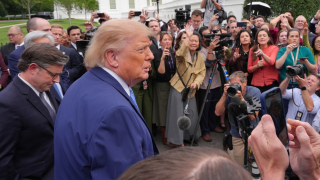
A Republican senator blocked an attempt in the U.S. Senate on Tuesday, September 29, to advance a resolution criticizing the Trump administration’s use of federal money for television advertisements featuring President Donald Trump. Sen. Maggie Hassan, Democrat of New Hampshire, sought unanimous consent for a resolution declaring that advertisements promoting the president and his policies should not be paid for by the U.S. government. Sen. Cynthia Lummis, Republican of Wyoming, objected, preventing the resolution from moving forward through that procedure.
The dispute comes as the White House faces growing scrutiny over a series of television advertisements that have appeared on national and local networks in the weeks before the 2026 midterm elections. The advertisements are marked at the end with the disclosure “Paid for by the US Government” and feature Trump prominently. Critics from both political parties have questioned whether federal resources should be used for messages that portray the president and his administration in favorable terms so close to an election.
Hassan's proposed resolution was framed as a statement of the Senate's position rather than a measure that would itself directly terminate the advertising campaign. According to the Washington Post, the resolution would have said that such advertisements “should not be paid for by the United States government.” Because Hassan attempted to advance it by unanimous consent, an objection from a single senator was enough to stop that effort without requiring a roll-call vote on the measure.
Lummis defended her objection by arguing that presidential administrations of both parties have historically used government-funded public service announcements. She cited former presidents Bill Clinton, George W. Bush, Barack Obama and Joe Biden as examples. Her argument was that criticism of Trump's advertisements should be considered alongside the broader history of presidents using government communications to speak directly to the public.
The White House has made a similar argument. In a September 25 statement, the administration described the Trump advertisements as “public service announcements,” saying they are not campaign advertisements because Trump is not currently on the ballot and the spots contain no direct call to action. The White House said the messages are intended to encourage patriotism and explain the administration's view of the country's direction, while pointing to public-service campaigns conducted by previous administrations.
The advertisements have nevertheless attracted criticism from some Republicans as well as Democrats. Senate Majority Leader John Thune has said he does not believe the federal government should be paying for the advertisements, according to the Washington Post. Republican Sen. John Kennedy of Louisiana has also publicly questioned whether government funds should be used to promote a public official. That bipartisan criticism has made the dispute different from a purely partisan disagreement over White House communications.
At the center of the controversy is the content of the advertisements. Reuters reported that three nationally broadcast ads had been aired, including messages celebrating what the administration describes as a “golden age of America” and another using rhetoric about combating communism and the “deep state.” One of the commercials closely resembles material used in Trump's 2024 presidential campaign, increasing questions about where government communications end and political messaging begins.
The financial side of the campaign has added to the debate. The Department of Homeland Security has identified $20 million for the advertising effort, according to reporting by the Associated Press. Federal contracting records and reporting by other news organizations indicate that money was moved into a U.S. Customs and Border Protection account designated for “commemorative events” before a contract for a national media campaign was awarded. More than $1 million had already been spent on television placements, with estimates varying as additional advertisements were broadcast.
The funding source is significant because the advertising is not being paid for through Trump's political committees. Instead, the administration has characterized the spending as a government communications effort. The distinction is at the heart of the legal debate: federal agencies routinely purchase advertising to explain programs, public safety information or government services, but federal law also contains restrictions concerning the use of appropriated money for propaganda and partisan political activity.
Public Citizen, a consumer advocacy organization, has filed complaints with the Federal Communications Commission, Federal Trade Commission and other federal bodies over the advertisements. The group argues that at least three of the commercials appear to violate federal restrictions on the use of taxpayer money for propaganda and partisan activity. It also disputes the administration's characterization of the spots as legitimate public service announcements, arguing that they do not provide information about a specific government program. These are allegations by the organization and have not been established as legal findings by a court.
The legal questions involve several different rules, making the issue more complicated than simply deciding whether an advertisement is political in tone. Public Citizen has cited federal restrictions on government propaganda as well as the Hatch Act, which places limits on partisan political activity by federal employees. Legal experts cited by FactCheck.org have similarly questioned whether the advertisements could cross the line from government communication into prohibited political messaging. The White House disputes that characterization and says the advertisements are lawful public-service communications.
The timing has also intensified scrutiny. The advertisements began appearing roughly five weeks before the November midterm elections, when control of Congress will be contested across the country. Reuters reported that the spots have appeared during high-profile programming, including professional and college football broadcasts, giving them a broad national audience. Critics have argued that the proximity to the elections makes the government's decision to prominently feature Trump especially consequential, while the administration maintains that the messages are not campaign advertising.
The disagreement also illustrates different interpretations of presidential public-service announcements. The White House points to earlier government campaigns under both Republican and Democratic administrations, including communications relating to Medicare, anti-drug efforts and national security. Critics counter that the current advertisements are different because Trump himself is prominently featured and some of the language and imagery closely resemble his campaign material. The factual comparison between past campaigns and the present advertisements remains part of the broader argument over how government communications should be defined.
For Congress, Tuesday's procedural dispute does not settle the underlying questions. Lummis's objection prevented Hassan's resolution from advancing through unanimous consent, but it does not itself constitute a formal congressional determination that the advertisements are lawful or unlawful. Further oversight could come through hearings, appropriations questions, agency reviews or additional legislative efforts. With Republicans controlling Congress, the scope and timing of any such action will depend on decisions by congressional leaders and committees.
The controversy may also receive additional attention from federal oversight organizations. Public Citizen has asked the Government Accountability Office and Office of Special Counsel to examine aspects of the advertising campaign, while complaints have also been sent to communications regulators. Whether those agencies take action, issue findings or decline to intervene remains unresolved.
The episode places the White House's communications strategy under a level of scrutiny that extends beyond the advertisements themselves. Questions about federal spending, the boundaries between government information and political promotion, and the role of presidential imagery in taxpayer-funded communications are now being debated by lawmakers, watchdog groups and legal experts. At the same time, the administration continues to defend the campaign as a legitimate public-service effort rather than election advertising.
For investors, government agencies and voters alike, the immediate issue is less about the existence of televised public-service messaging than about the standards governing its content and financing. The Senate's failure to advance Hassan's resolution leaves those questions unresolved. As the November midterms approach, additional advertisements, congressional scrutiny and possible regulatory or legal reviews could determine whether the dispute remains a political controversy or develops into a broader examination of federal rules governing taxpayer-funded communications.
Original references
Sources & further reading
- The Washington Post — Senate resolution blocked ↗www.washingtonpost.com
- Reuters — Trump government ads draw scrutiny ↗www.reuters.com
- Associated Press — DHS taps $20 million for ads ↗apnews.com
- The White House — Presidential public service announcements ↗www.whitehouse.gov
- Public Citizen — FCC and FTC complaint ↗www.citizen.org
- Roll Call — Lawmakers question publicly funded ads ↗rollcall.com