
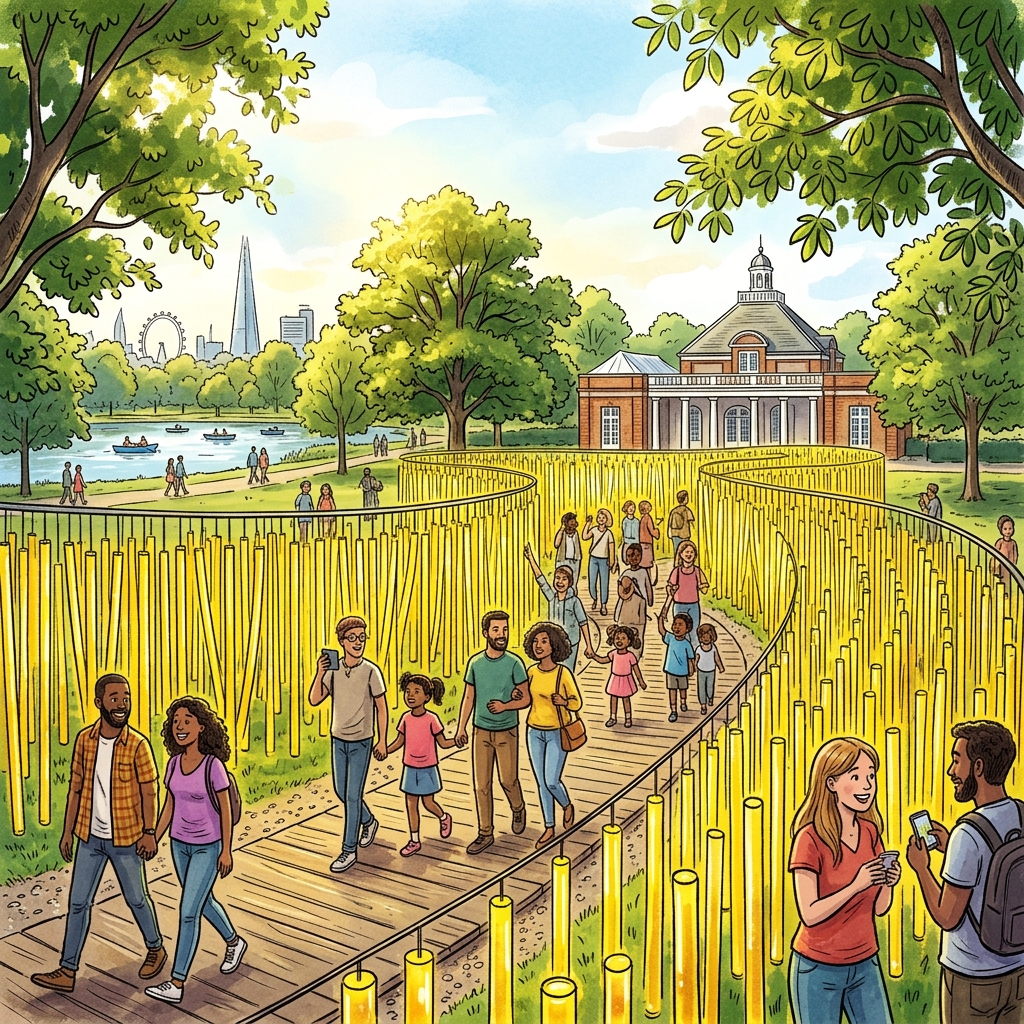
Art in the Park 2026 is bringing large-scale contemporary art into the open landscape of Kensington Gardens, with Serpentine presenting Venezuelan kinetic-art pioneer Jesús Rafael Soto's immersive sculpture *Pénétrable BBL Jaune*. The work is on display beside Serpentine South from June 16 through October 25, 2026, and is free for the public to experience. Rather than functioning as a conventional sculpture viewed from a distance, the installation asks visitors to physically walk through it, making participation an essential part of the artwork. Serpentine describes the presentation as part of its wider programme of bringing art beyond gallery walls and into the surrounding parkland.
The centrepiece of this year's outdoor programme is striking in both scale and simplicity. *Pénétrable BBL Jaune* measures around 10 metres in length and consists of 4,000 suspended yellow PVC tubes attached to a rectangular steel structure. Seen from a distance, the closely arranged vertical lines produce a shimmering visual effect, while entering the structure creates an entirely different experience. As visitors walk between and push against the strands, the tubes move around them, changing the appearance of the installation. Serpentine says the work's moiré effect makes the lines seem to flicker and shift, reinforcing Soto's long-standing interest in perception and movement.
That interaction is central to the meaning of Art in the Park 2026. Soto believed that an audience should not remain separated from an artwork. His *Pénétrable* series, which began in 1967, was developed around the idea that the viewer could enter the work and alter the experience through physical presence. More than 70 versions were created during his career, using different dimensions and colours. Serpentine's presentation places that philosophy directly into a public park, where visitors can encounter the piece without entering a museum or following a conventional exhibition route.
For Soto, movement was not simply an effect added to a finished object. It was part of the artwork's structure. The *Pénétrables* blur the distinction between sculpture and environment because the boundaries of the work become difficult to define once a person enters. The hanging tubes surround the visitor, while the movement of the body changes how the structure looks and feels. Two people can therefore experience the same installation differently depending on where they stand, how they move and how they interact with the strands.
This approach also explains why Soto's work remains relevant to contemporary audiences. Art institutions increasingly experiment with immersive exhibitions, interactive environments and installations designed for audience participation. Much of today's immersive art relies on digital projection, sensors and computer-generated environments. Soto's work explores similar questions through simple physical materials. His sculpture demonstrates that an environment can respond to the presence of a visitor without requiring screens, software or virtual reality.
Art in the Park is particularly suited to this kind of work because Kensington Gardens itself becomes part of the experience. Serpentine's galleries sit within the park, and the institution has long used the surrounding landscape as an extension of its programme. The Royal Parks describes the gardens as a major destination for contemporary art and architecture, with Serpentine North and South providing exhibitions alongside the annual Pavilion programme. The setting allows visitors to move from galleries and architectural installations into a large outdoor environment where artworks can be encountered alongside everyday park life.
The 2026 programme is also taking place alongside the 25th Serpentine Pavilion, designed by Mexico City-based LANZA atelier. The Pavilion opened in June and forms another major part of the institution's summer programme. Serpentine's wider 2026 schedule includes exhibitions by David Hockney, Cecily Brown and Amar Kanwar, as well as talks and performances. In this context, Soto's sculpture provides an outdoor, participatory counterpoint to works being presented inside the galleries.
The public-art project represents the first outdoor presentation of Soto's work in the United Kingdom. Serpentine says Soto's sculpture was selected to launch a dynamic summer programme in the park, extending its artistic activity into the surrounding landscape. The installation therefore has both a historical and contemporary dimension: it revisits a major work by a 20th-century artist while placing it in a setting designed for constant public movement.
The particular work has its own unusual history. *Pénétrable BBL Jaune* was originally created in 1999 and has been presented in a 2023 edition. According to Serpentine, the current work is credited as *Pénétrable BBL Jaune (1999; 2023 Edition)*. Its re-presentation demonstrates how Soto's family, estate and collaborators have continued to make his work available to new audiences more than two decades after his death.
Soto was born in Ciudad Bolívar, Venezuela, in 1923 and died in Paris in 2005. He became one of the leading figures associated with kinetic art, a movement that challenged fixed ideas about how viewers experience images and objects. His practice included drawing, painting, sculpture and installation, with recurring attention to movement, space, repetition and tactility. Major institutions that have exhibited or collected his work include the Solomon R. Guggenheim Museum in New York, the Musée National d'Art Moderne in Paris, Tate in London, MoMA in New York and Guggenheim Bilbao.
His importance to kinetic art becomes particularly clear in a work such as *Pénétrable BBL Jaune*. There is no motorized mechanism creating a theatrical performance. The visual instability comes from the relationship between the materials and the viewer. From one angle, the strands can appear almost like a solid block of yellow. From another, they separate into individual lines. Once somebody walks through the installation, the strands move, overlap and create changing patterns.
The result is an artwork that is never visually identical. Morning and afternoon visitors may encounter different levels of movement depending on how crowded the installation is and how people approach it. A single visitor moving slowly through the strands creates one kind of experience, while a group moving in different directions creates another. The constantly changing environment reflects Soto's interest in time and perception rather than a fixed visual composition.
The idea of participation is reinforced by the physical scale of the sculpture. At approximately 10 metres long, the work is large enough to create the sensation of entering an independent environment rather than simply passing through a small installation. The dense yellow strands surround the visitor and partially obscure the park beyond them. The familiar landscape becomes fragmented and layered, while the sculpture itself changes with every movement.
This approach can make the artwork accessible to people who might not normally consider themselves art enthusiasts. Visitors do not need a detailed knowledge of kinetic-art history to understand what is happening. The physical experience provides an immediate introduction: the sculpture looks different from outside, behaves differently once someone enters and reacts to movement. That accessibility is particularly valuable for an outdoor public-art project designed to reach a broad audience.
Serpentine's decision to make the installation free also supports that goal. The institution's public-art listing describes the Soto presentation as free to visit, allowing people to encounter the sculpture without buying a gallery ticket. The installation is also situated in Kensington Gardens, meaning visitors can incorporate it into a wider visit to one of London's best-known parks.
Art in the Park 2026 also illustrates how public art can create connections between contemporary culture and everyday city life. A museum exhibition creates a controlled environment in which visitors deliberately enter a space to see art. A park installation operates differently. People might discover the sculpture while walking, exercising, meeting friends or visiting the gardens. That accidental encounter can bring art into contact with audiences who may never have planned to visit an exhibition.
The outdoor setting also changes the visual character of Soto's work. Natural light interacts with the yellow tubes, while trees, sky and surrounding architecture appear through the gaps. Weather and time of day can subtly alter the atmosphere. In a gallery, the artist controls many of the surrounding conditions. In a public garden, the environment remains active and unpredictable, adding another layer to an artwork already designed around movement.
The project is being supported as part of Serpentine's wider 2026 summer programme. The institution's press information lists the Soto sculpture alongside the Pavilion and other artistic projects taking place around Kensington Gardens. A July announcement from MP Publishing, distributed through PR Newswire, highlighted the installation as the launch of Serpentine's 2026 Art in the Park summer programme and identified Britannia Financial Group as a sponsor.
The partnership between cultural institutions and private supporters is increasingly important to London's public-art landscape. Serpentine's programming relies on a mixture of philanthropic support, partnerships and institutional resources to keep many projects free or accessible to the public. In the case of *Pénétrable BBL Jaune*, Serpentine credits Britannia Financial Group with making the presentation possible, while its broader park programme has additional supporters.
The project also fits into a longer history of Serpentine using the park as a space for artistic experimentation. The institution's annual Pavilion has become a major architectural event, while outdoor artworks and performances extend the programme beyond the gallery buildings. In 2026, the combination of the Pavilion, Soto's sculpture and the surrounding exhibitions creates a concentrated summer arts programme across Kensington Gardens.
For Soto's legacy, the London presentation is significant because it allows an important work from his later career to be experienced in exactly the kind of participatory way he intended. Visitors are not looking at an image of kinetic art or reading about the theory behind it. They physically enter the structure, move through the strands and watch the environment change around them.
That physical relationship is what separates *Pénétrable BBL Jaune* from a conventional monument or sculpture. It is not primarily about representing an object. Instead, it creates a temporary environment in which the relationship between body, space and perception becomes the subject. The sculpture effectively turns the viewer into an active participant.
The installation also provides an unusual meeting point between historical art and contemporary expectations about immersive experiences. Younger visitors familiar with interactive digital media may recognize the principle immediately: their actions affect what they see. Yet Soto was developing this concept decades before smartphones, virtual reality and responsive digital installations became widespread.
As immersive technology continues to reshape museums and entertainment venues, Soto's work offers a different model for participation. It uses physical space instead of a screen, movement instead of software and perception instead of digital effects. That simplicity makes the work feel surprisingly contemporary despite its origins in the late 20th century.
Art in the Park 2026 therefore functions on several levels. It is a public art programme, a presentation of an important Venezuelan artist, an outdoor cultural experience and an example of how historic ideas about participation can remain relevant to modern audiences. The sculpture's location ensures that its success does not depend entirely on people arriving with expectations about what contemporary art should look like.
For London visitors, the experience is straightforward: walk into the yellow field, move through the hanging tubes and watch the structure change. For art historians, the installation offers a live example of Soto's theories about movement and participation. For Serpentine, it strengthens a programme that increasingly treats Kensington Gardens as an extension of the gallery rather than merely its surroundings.
The sculpture is scheduled to remain in place until October 25, giving audiences through the autumn to experience it. Serpentine's official programme confirms that the work is free and located at Serpentine South in Kensington Gardens.
As the 2026 summer programme moves into its final weeks, *Pénétrable BBL Jaune* stands as one of its most physically engaging projects. It does not ask visitors to stand quietly and observe. Instead, it invites them to enter, touch and move — making the audience part of the artwork itself.
**What to Watch Next:**
Art in the Park 2026 will continue at Serpentine through the presentation of *Pénétrable BBL Jaune* until October 25. Visitors can also follow the wider Serpentine programme, including the 2026 Pavilion and exhibitions continuing into the autumn. The next major development will be the closing of the Soto installation and the transition to Serpentine's autumn public-art and exhibition programme.