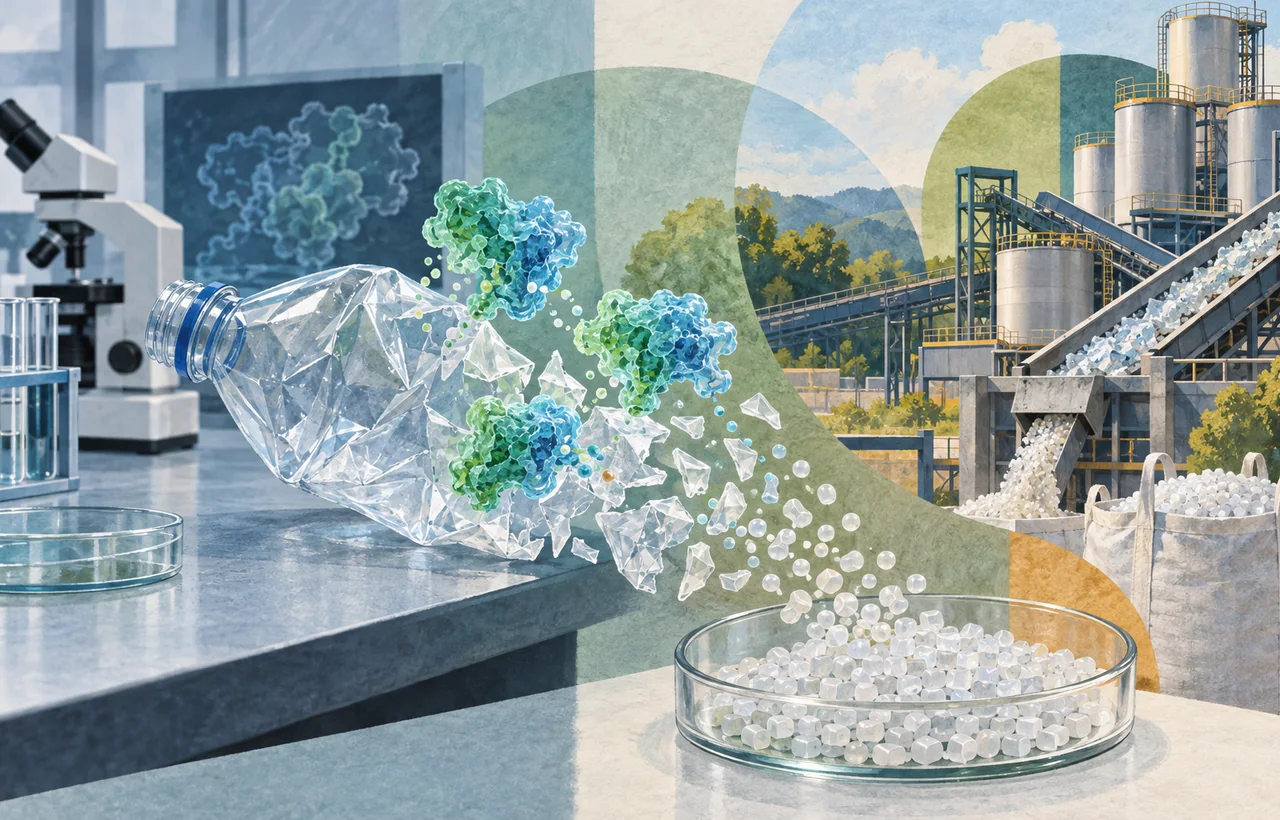
Enzymatic recycling is promising because it can break some polymers into building blocks that may be reused. The promise is specific: controlled processing of compatible material, not an enzyme released into the sea.
What the process can do
Engineered enzymes can accelerate the breakdown of polymers such as PET when temperature, particle size and contamination are controlled. The resulting molecules can potentially become feedstock for new material.
Performance depends on the plastic. Packaging contains dyes, adhesives, multilayer films and additives that can obstruct the reaction or require separate treatment.
The scale test
A commercial process must collect and sort enough suitable waste, run efficiently, recover useful output and compete with virgin material and other recycling routes. Energy, water and chemical inputs belong in the calculation.
Life-cycle assessment should compare the whole system, including transport and pretreatment, rather than reporting only the speed of a laboratory reaction.
Why prevention still comes first
Plastic dispersed in rivers and oceans is mixed, weathered and expensive to retrieve. Enzymes do not replace product redesign, reuse, collection or controls on waste leakage.
The technology is most credible as one tool in a circular system: prevent avoidable material, collect what is used, sort it well and apply the recycling method that fits the polymer.