
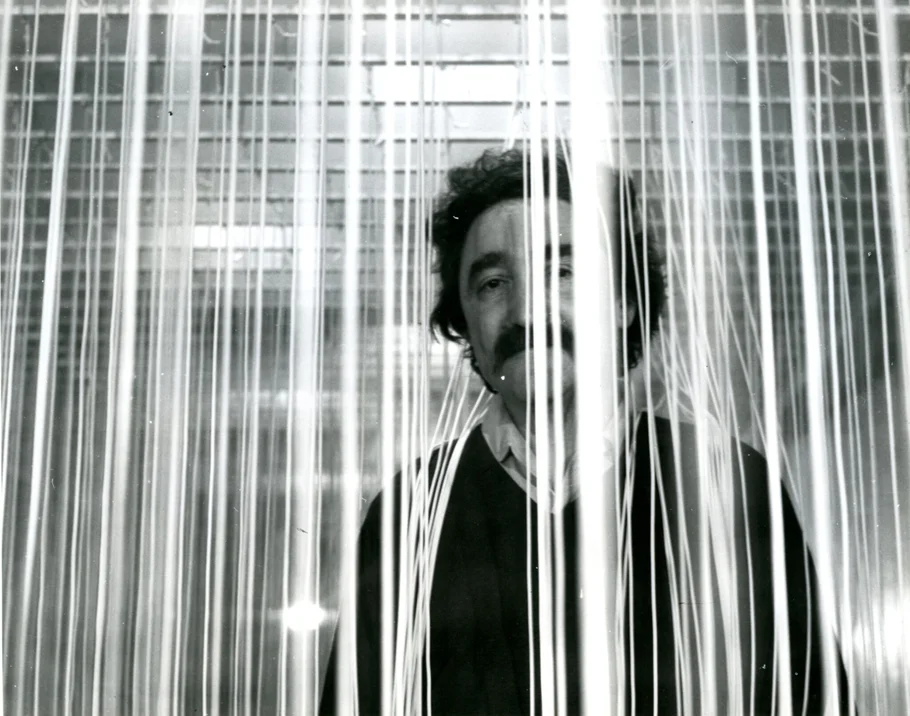
Jesús Rafael Soto, one of the major figures in 20th-century kinetic art, is back at the centre of London's art scene through a large-scale public installation in Kensington Gardens. His immersive sculpture *Pénétrable BBL Jaune* is on view at Serpentine South through October 25, 2026, giving visitors an opportunity to physically enter one of Soto's best-known artistic ideas. The work is free to visit and represents the first outdoor presentation of Soto's work in the United Kingdom. Rather than being an artwork intended simply to be viewed from a distance, the installation depends on the movement of the people who enter it, making the visitor part of the visual experience.
Soto was born in Ciudad Bolívar, Venezuela, in 1923 and died in Paris in 2005. Over a career spanning more than five decades, he became internationally recognized for exploring movement, perception, repetition, light and the relationship between objects and the viewer. His work is closely associated with the European kinetic and optical-art movements that challenged traditional ideas about painting and sculpture. Rather than treating an artwork as a fixed object, Soto repeatedly investigated how apparently simple lines, colours and suspended elements could produce the sensation of movement in the eye and body.
The London installation brings that approach into a public garden. *Pénétrable BBL Jaune* consists of around 4,000 suspended yellow PVC tubes arranged within a steel framework approximately 10 metres long. From the outside, the dense strands appear as a shimmering wall of colour. But once visitors walk inside, the structure changes dramatically. The hanging elements move as people pass through them, creating shifting patterns of colour, sound, transparency and depth. The work can look different from one moment to the next because every visitor approaches and moves through it differently.
That physical participation is fundamental to Soto's artistic philosophy. The *Pénétrable* series began in 1967, and the artist went on to create more than 70 versions in different colours and dimensions. The works were designed to eliminate the traditional separation between viewer and artwork. Instead of standing outside a sculpture and looking at it, the viewer enters the piece, touches its elements and changes the surrounding visual field through movement. The artwork is therefore not entirely complete until somebody interacts with it.
The particular London installation has an interesting history. *Pénétrable BBL Jaune* was originally conceived by Soto in 1999, while the version presented at Serpentine is a 2023 edition produced in connection with the artist's estate. The work was developed from Soto's original design and is now being shown in a contemporary public setting that places its ideas about movement and perception directly alongside nature, architecture and everyday urban life.
The choice of Kensington Gardens is significant because the installation changes the way people experience the surrounding landscape. Inside the yellow strands, the familiar park environment becomes partially obscured and fragmented. Visitors can see people moving outside the sculpture through layers of colour while their own movement causes the hanging tubes to shift. The garden therefore becomes part of the artwork rather than merely serving as a backdrop.
Serpentine has described the sculpture as part of its 2026 public-art programme. The institution's programme lists the installation from June 16 through October 25, with free public access at Serpentine South in Kensington Gardens. The presentation places Soto's work alongside a broader programme of exhibitions, architecture and public projects taking place at the galleries and throughout the park during the summer and autumn.
The installation is also notable because Soto's work has recently received renewed institutional attention internationally. In Paris, *Soto: Une traversée cinétique* was presented at the Cité de l'architecture et du patrimoine from May 20 through August 31, 2026. The official Soto exhibition archive lists the Paris presentation alongside the current London project, showing the continued interest in revisiting his work through major European institutions more than two decades after his death.
Soto's reputation is not limited to exhibitions in galleries. His *Pénétrables* have become among the most recognizable examples of immersive kinetic art. Major institutions and collections around the world have preserved and displayed his work, while his influence can be seen in later approaches to installation art, immersive environments and interactive sculpture. His contribution is particularly important because he anticipated a central idea of contemporary art: that the viewer does not necessarily have to remain a passive observer.
His practice also connects closely with the history of Latin American modernism. During the 1950s and 1960s, Soto became part of an international network of artists exploring abstraction, geometric form, optical effects and movement. Paris was an important centre for this experimentation, and Soto developed relationships with artists associated with the broader kinetic-art movement. His work nevertheless retained a distinctive identity based on repetition, transparency and the physical participation of the viewer.
One of the striking aspects of Soto's approach is how little material is needed to create such a strong perceptual effect. The *Pénétrable* installation uses thousands of simple plastic strands, yet the collective effect can transform a large architectural space into something that feels unstable and constantly changing. The individual pieces are relatively straightforward; it is their repetition, arrangement and interaction with the viewer that produce the complexity.
That idea is especially relevant in an era increasingly dominated by digital immersive experiences. Modern museums and entertainment venues often rely on projection mapping, computer graphics, sensors and interactive screens to create environments that respond to visitors. Soto achieved a related form of participation decades earlier using physical materials, light and human movement. His work demonstrates that an immersive experience does not necessarily require digital technology.
The optical phenomenon is also central to understanding why the sculpture feels animated. When the closely packed vertical strands overlap and move relative to one another, viewers can experience changing patterns and apparent vibration. The effect varies according to the viewer's position, the direction of movement and the interaction between the strands. The result is not a conventional moving sculpture with a motor or mechanical mechanism; the movement is largely produced through perception and participation.
That quality has helped keep Soto's work relevant to contemporary audiences. His sculptures can be experienced without specialist knowledge of art history. A visitor does not need to understand the theoretical history of kinetic art to notice that the yellow structure looks different from different angles or that entering it changes the experience completely. The physical simplicity of the work makes its underlying ideas unusually accessible.
The London presentation also comes at a time when public art is increasingly being used to transform the experience of major urban spaces. Large-scale installations can attract visitors who might not normally enter a museum, while giving established institutions an opportunity to bring art into everyday environments. Soto's sculpture fits particularly well into that model because it is designed to be approached, entered and physically experienced.
There is also a strong environmental dimension to the setting, even though the sculpture itself was created decades ago. In a traditional gallery, the controlled surroundings can make it easier to isolate an artwork from external distractions. In Kensington Gardens, weather, daylight, surrounding trees and passing visitors become part of the experience. The sculpture can therefore appear different in sunlight, cloudier conditions and changing levels of activity, reinforcing Soto's interest in an artwork that is never visually identical from one moment to another.
The renewed attention is also visible in the art market. Dorotheum records a Jesús Rafael Soto work selling for €208,000 in May 2026, against an estimate of €150,000 to €200,000. Art-market databases also show numerous Soto works appearing in auctions during 2026. Auction results provide only a partial view of an artist's market and vary substantially by work, size, medium and provenance, but the activity indicates continued collector interest in his work.
Soto's market profile, however, is only one part of the current story. The continuing institutional presentation of his work may be more significant for his historical legacy because it places his ideas in front of new audiences. A public installation such as *Pénétrable BBL Jaune* can reach families, tourists, students and casual park visitors alongside established art audiences, allowing an artist whose major experiments began more than half a century ago to be encountered in a contemporary setting.
His influence can also be understood through his emphasis on the fourth dimension: time. A painting traditionally occupies two dimensions, while a sculpture occupies three. Soto's work introduces a fourth element through the passage of the viewer through space and the changing perception of the artwork over time. The physical movement of visitors becomes part of the composition. This approach was central to major retrospectives of his work, including the Guggenheim Museum Bilbao's *Soto: The Fourth Dimension*.
That concept makes *Pénétrable BBL Jaune* particularly appropriate for a public environment. There is no single correct viewpoint. A person standing outside sees a dense yellow volume. Another person walking through it experiences an almost tunnel-like environment. From farther away, the structure can appear as a solid field of colour, while close-up the individual strands become visible. The artwork changes because the visitor changes position.
Soto's work also challenges the idea that an artwork must preserve a fixed appearance. In many forms of traditional sculpture, conservation means maintaining the physical object in a stable condition. In a *Pénétrable*, the intended experience includes constant movement. Tubes swing, people enter and leave, and the visual effect changes continuously. The instability is not a defect; it is part of the artwork.
That makes the London exhibition an opportunity to reconsider the relationship between art and technology as well. Soto did not use digital interfaces or artificial intelligence, yet his work asks questions that remain relevant to today's immersive media: How does an environment respond to a user? How does movement change information? Can a viewer become part of the system rather than simply consuming it? Those questions are now common in digital design, virtual reality and interactive installations, but Soto was exploring related ideas through physical space decades earlier.
The Serpentine presentation therefore represents more than a display of a historic sculpture. It is a continuation of an artistic experiment about perception, participation and space. Visitors are not simply looking at a work made in 1999; they are completing an experience that depends on their own movements in 2026.
For London, the sculpture adds a striking visual landmark to Kensington Gardens. For Soto's legacy, it provides another example of how his ideas can adapt to different contexts without losing their central character. And for new audiences, it offers an unusually direct introduction to kinetic art — one in which touching, walking and moving through the work are not distractions from the artwork but the reason it exists.
Jesús Rafael Soto may have died in 2005, but his work continues to operate through the participation of living audiences. The current Serpentine installation makes that especially clear. Thousands of yellow strands hang almost motionless until people enter them. Then the artwork comes alive through movement, perception and interaction — precisely the principles that defined Soto's artistic vision.
With *Pénétrable BBL Jaune* remaining at Serpentine South until October 25, 2026, London's current presentation offers a timely reminder of why Soto remains an important figure in kinetic art. His work does not merely represent movement. It asks the viewer to become the movement.
**What to Watch Next:**
The Serpentine installation remains on view in Kensington Gardens through October 25, 2026, while Soto's wider exhibition history continues to attract institutional and collector attention. The next developments to follow include further international museum presentations, public-art projects and auction activity surrounding his work.