Why Robotic Pizza Makers Are Struggling to Replace Human Workers
The dream of replacing human kitchen workers with robotic pizza makers has run into.
The problems facing robotic pizza makers are not limited to one company. The sector has already seen several ambitious businesses disappear or abandon major portions of their plans. Zume, once one of Silicon Valley's best-known automated pizza ventures, attracted hundreds of millions of dollars in investment before shutting down its pizza operation. Pazzi, a French company that developed robotic arms capable of preparing pizzas with minimal human intervention, also disappeared after struggling to build a commercially sustainable business. Basil Street, meanwhile, pursued automated pizza vending machines that could prepare and sell pizzas without a conventional restaurant kitchen. Together, these failures have weakened confidence in the idea that pizza is an easy first step toward fully automated food preparation. Although preparing a standardized product may sound like an ideal robotics problem, real restaurants introduce dozens of variables that are difficult for machines to handle reliably.
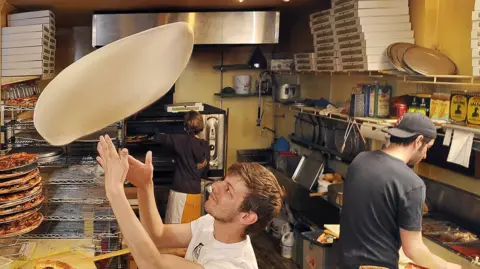
One of the biggest challenges is that humans are already remarkably efficient at making pizza. Workers can stretch dough, recognize when it feels right, adjust the amount of sauce, compensate for uneven ingredients and change their technique almost instantly. A robot, by contrast, may need precisely calibrated equipment for each step. Ingredients can move unexpectedly, dough can change shape, toppings can fall outside designated areas and machinery can require constant maintenance. Sara Senatore, a senior restaurants analyst at Bank of America, told the BBC that businesses have not yet seen the success stories many expected from restaurant robotics. She noted that food-preparation robots can be clumsy and may occasionally place ingredients incorrectly, while human workers can adapt naturally to small variations. This highlights a central problem with automation: the machine may work perfectly under controlled conditions, but restaurants rarely remain controlled environments for long.
The financial equation can also be difficult to justify. Restaurants operate on relatively thin margins, meaning expensive automation equipment has to deliver reliable savings before it becomes worthwhile. A robot costing tens or hundreds of thousands of dollars does not necessarily reduce labor costs enough to recover that investment quickly. Businesses must also account for electricity, maintenance, software updates, spare parts, repairs and technical support. The experience of Moto Pizza illustrates how serious the support problem can become. When Picnic shut down, the restaurant did not simply lose a software subscription; it effectively lost the company that knew how to maintain the machines. What had been presented as a long-term automation investment suddenly became specialized equipment without a functioning supplier behind it. That creates a level of operational risk very different from hiring and training human employees.
Yet the story is more complicated than simply saying that pizza robots do not work. Some restaurant operators have reported meaningful benefits from automation, particularly when robots are used to handle repetitive tasks rather than completely replace people. Kindell himself said that when Picnic's machines were used at T-Mobile Park, home of the Seattle Mariners, the number of workers directly involved in pizza production fell from around ten to two. However, he argued that the remaining workers were not simply dismissed. Instead, they moved into customer-facing roles, including distributing food and promoting the pizza around the stadium. According to Kindell, the automation allowed the operation to serve customers faster and redeploy employees to areas where human interaction added more value. This suggests that the strongest application for robotics may not be a completely worker-free restaurant but a hybrid model in which machines handle repetitive preparation while people remain responsible for service and customer experience.
Another company is taking a different approach by focusing on speed and continuous availability. Canadian robotics firm Appetronix installed a robotic pizza unit at John Glenn Columbus International Airport in Ohio for the Donatos pizza chain. Unlike a traditional restaurant kitchen, such a system can potentially operate around the clock, making it especially attractive in locations where labor availability is difficult or demand occurs outside conventional meal times. Airport environments, hospitals, universities and transportation hubs could therefore become more realistic early markets for food automation because customers value convenience and constant availability. In these settings, a standardized product may be easier for a machine to produce consistently than an artisanal pizza restaurant where customers expect customized preparation and personal service.
Customer expectations may ultimately be just as important as the technology itself. Pizza is not only a food product; for many businesses it is also part of the dining experience. Restaurant owners who emphasize craftsmanship, hospitality and personal interaction may see little reason to replace workers with machines even if robots become technically reliable. Paul Giannone, owner of the Paulie Gee's pizza restaurants, told the BBC that he still would not use robots because his restaurants prioritize personal customer service. This illustrates a broader divide within food technology: some businesses compete primarily on speed, volume and consistency, while others compete on atmosphere, craftsmanship and human connection. A technology that works extremely well for the first group may be completely unsuitable for the second.
There are also concerns about employment. Restaurant work provides a large number of entry-level jobs, particularly for younger workers and people entering the workforce. Large-scale automation could reduce the number of workers required for food preparation, potentially removing an important pathway into employment. Supporters of automation argue that machines will eliminate repetitive work while allowing employees to move into customer service, supervision and other higher-value roles. Critics counter that not every restaurant will retain workers in redesigned positions, particularly if the primary motivation for installing robots is to cut costs. The debate is similar to automation discussions across manufacturing, logistics and retail, where technology can increase productivity while simultaneously changing the type and number of jobs available.
Despite recent failures, investment and research into restaurant robotics have not disappeared. Some of the technologies developed by failed startups are being reused by newer companies. Miso Robotics, a California-based robotics company known for its Flippy robotic frying system, acquired more than 300 patents previously owned by Zume. Miso chief executive Rich Hull argued that Zume's vision for robotic pizza production was fundamentally sound but arrived too early for the market. His view reflects a broader pattern in technology development: a product can fail commercially without the underlying technology being useless. Hardware costs may eventually fall, artificial intelligence may improve machine control and restaurants may become more comfortable integrating robotics into everyday operations.
The next generation of pizza robots may therefore look very different from the bulky machines that have struggled in earlier experiments. Advances in computer vision, machine learning, precision motors and sensor technology could allow robots to better handle variations in dough, toppings and cooking conditions. Instead of attempting to automate every step of a restaurant, future systems may focus on individual tasks where machines offer a clear advantage. This could include portioning ingredients, dispensing toppings, monitoring ovens, preparing standardized menu items or operating vending-style kitchens. Smaller and modular systems may also reduce the financial risk for restaurant operators because businesses would no longer need to commit hundreds of thousands of dollars to one giant machine.
For Moto Pizza's Lee Kindell, the setbacks have not ended the dream. Despite his experience with Picnic's shutdown, he is developing his own pizza-making robot and believes he could have a working version by summer 2027. His concept is inspired by the way 3D printers operate and is designed to produce square pan-style pizzas. Kindell acknowledges that he has no previous professional robotics experience, but he believes the failures of earlier companies have generated valuable lessons about how the technology should be designed. His determination reflects the continuing appeal of the idea: a customer walks up to a kiosk, places an order and receives a freshly prepared pizza without needing a conventional kitchen full of staff.
The current failures therefore do not necessarily mean robotic pizza makers are finished. Instead, they suggest the technology may have been introduced before the economics and engineering were ready. Automation works best when a task is repetitive, predictable and expensive enough in labor costs to justify replacing or assisting people. Pizza production meets some of those conditions but not all of them. Dough behaves differently, ingredients vary, customers customize orders and restaurants depend heavily on human service. The challenge for robotics companies is not simply building a machine capable of making a pizza; it is building one that can do so cheaply, reliably, flexibly and continuously while fitting naturally into the economics of a real restaurant.
For now, the pizza robot revolution remains unfinished. The industry has produced ambitious prototypes, eye-catching demonstrations and enormous promises, but very few long-term commercial success stories. Some businesses have lost large amounts of money, while others have discovered that the machines work best as assistants rather than replacements for people. The technology will almost certainly continue developing, but the future of automated pizza may depend less on creating a perfect robot chef and more on finding the specific restaurant environments where robotics genuinely solves a business problem. As Kindell puts it, the question may no longer be whether a fully autonomous pizza robot can exist, but who will finally make one that actually makes financial sense.
Related Post

Apple May Bring iPhone Clipboard Sharing to Windows PCs With New Cross-Platform Feature

Snapchat Introduces New Measures to Fight Low-Quality AI Content Across Its Platform

Linus Torvalds Says AI-Driven Bug Finding Has Made Huge Linux Kernel Updates the New Normal

Xbox Elite Series 3 Controller Leak Reveals Built-In Screen, Cloud Gaming Features and Replaceable Battery
RECENT POST
- »Why Robotic Pizza Makers Are Struggling to Replace Human Workers
- »Judge Rules Trump Administration Unlawfully Retaliated Against Anthropic
- »Electric Gardening Equipment Is Replacing Petrol Tools as Landscapers Go Greener
- »Shein Sets $27 Billion Valuation Target for Hong Kong IPO as Growth Slows
- »TikTok Agrees to $400 Million US Settlement Over Children's Privacy Violations