US Retail Sales Surge as Iran War Drives Gas Prices Higher
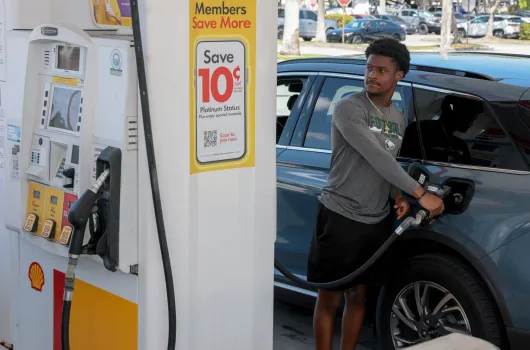
U.S. retail sales increased more than expected in March as the war with Iran boosted gasoline prices and led to a record surge in receipts at service stations, while tax refunds underpinned spending elsewhere.
Retail sales jumped 1.7% last month, the largest rise since March 2025, after an upwardly revised 0.7% gain in February. Economists had forecast a 1.4% increase. The spike in gas prices due to the Iran war, now in its eighth week, resulted in the fastest one-month increase in retail sales in more than three years.
Sales at gasoline stations surged 15.5%, the largest gain since the government started tracking the series in 1992. The Middle East conflict has sent global oil prices jumping more than 30%, with retail gasoline prices soaring 24.1% in March. Americans saw large portions of their spending go toward fuel, though consumers still had money left to spend elsewhere.
This isn't really a story about 'people are spending more.' It's more like 'people are being forced to spend more.' A lot of that jump is just the fact that gas prices are going up.
Consumer Spending Trends and Mixed Behavior
Shoppers accelerated their spending in March from February, but they spent a good chunk of their money at the gas pump. Excluding gas prices, retail sales were up 0.6%, supported in part by government tax refunds and seasonal factors. Sales at department stores rose 4.2%, furniture and home furnishings stores increased 2.2%, and online retailers saw a 1% gain.
Electronics and appliance stores posted a 0.9% increase, while building material and garden equipment store sales also rose. But people cut back on spending that wasn't necessary, so restaurant sales only went up 0.1% and clothing sales stayed the same. Economists said that eating out is one of the first things people stop doing when they are short on cash.
Impact of Inflation and Economic Pressures
The jump in gas prices caused a sharp spike in inflation, with the Consumer Price Index increasing 0.9% in March, the largest monthly gain in nearly four years. Consumer prices rose 3.3% compared to a year earlier, driven largely by higher fuel costs.
Gas prices going up is like a tax on spending. This makes it harder for people to buy things they don't need and puts more strain on their finances. People were worried about the war and rising prices in April, which made consumer confidence drop to an all-time low. Families have been spending money using savings, tax refunds, and credit, but these sources may not last forever.
Economic Outlook and Growth Projections
Even though inflation is a problem, economists raised their estimates for economic growth in the first quarter because retail sales were so strong. Economists at Morgan Stanley raised their consumer spending growth estimate, while Goldman Sachs boosted its GDP growth projection to 3.3%.
The so-called core retail sales, which closely track consumer spending in GDP calculations, increased 0.7% in March. The data suggests households remain resilient for now, supported by tax refunds and savings. But economists think that spending will slow down in the next few months as the effects of tax refunds wear off and fuel prices stay high.
Broader Risks from War and Future Uncertainty
The Iran war has disrupted global oil supply, including the shutdown of the Strait of Hormuz, which carries about one-fifth of the world’s oil. Rising fuel costs are making transportation more expensive, and they are likely to raise prices throughout the supply chain. People are already changing how they spend money, moving it from things they don't need to things they do.
Economists say that a long-lasting conflict could have a big negative effect on consumer spending and the economy as a whole. The main question is still how long the war will last. If it lasts too long, it could make things worse for families and businesses.
The situation today feels unique, but we've faced down threats like this before.
The big question is how long this will last. If gas prices stay high, people will probably stop buying things they don't need, which is when the economy as a whole might start to feel it.

Michael Chen
Michael Chen provides deep dives into consumer trends and global economic shifts.
Related Post
Trump’s 15% Tariff Shock Sends U.S. Stock Futures Lower, Fuels Inflation Fears

AI-Augmented Innovation: How Corporations are Rewriting the R&D Playbook

The Circular Economy Mandate: Retail's 2026 Sustainability Pivot

Nvidia CEO Jensen Huang Says Markets Are Wrong About AI Threat to Software Companies
RECENT POST
- »Emerging Markets 2026: The Rise of the 'Digital Tiger' Economies
- »Family Offices in 2026: Shifting from Preservation to Planetary Impact
- »The 2026 Midterm Shift: A Deep Dive into the Battle for the House
- »Trump’s 15% Tariff Shock Sends U.S. Stock Futures Lower, Fuels Inflation Fears
- »Alzheimer’s Prediction Tool: Blood Test Estimates Symptom Onset Within 3–4 Years