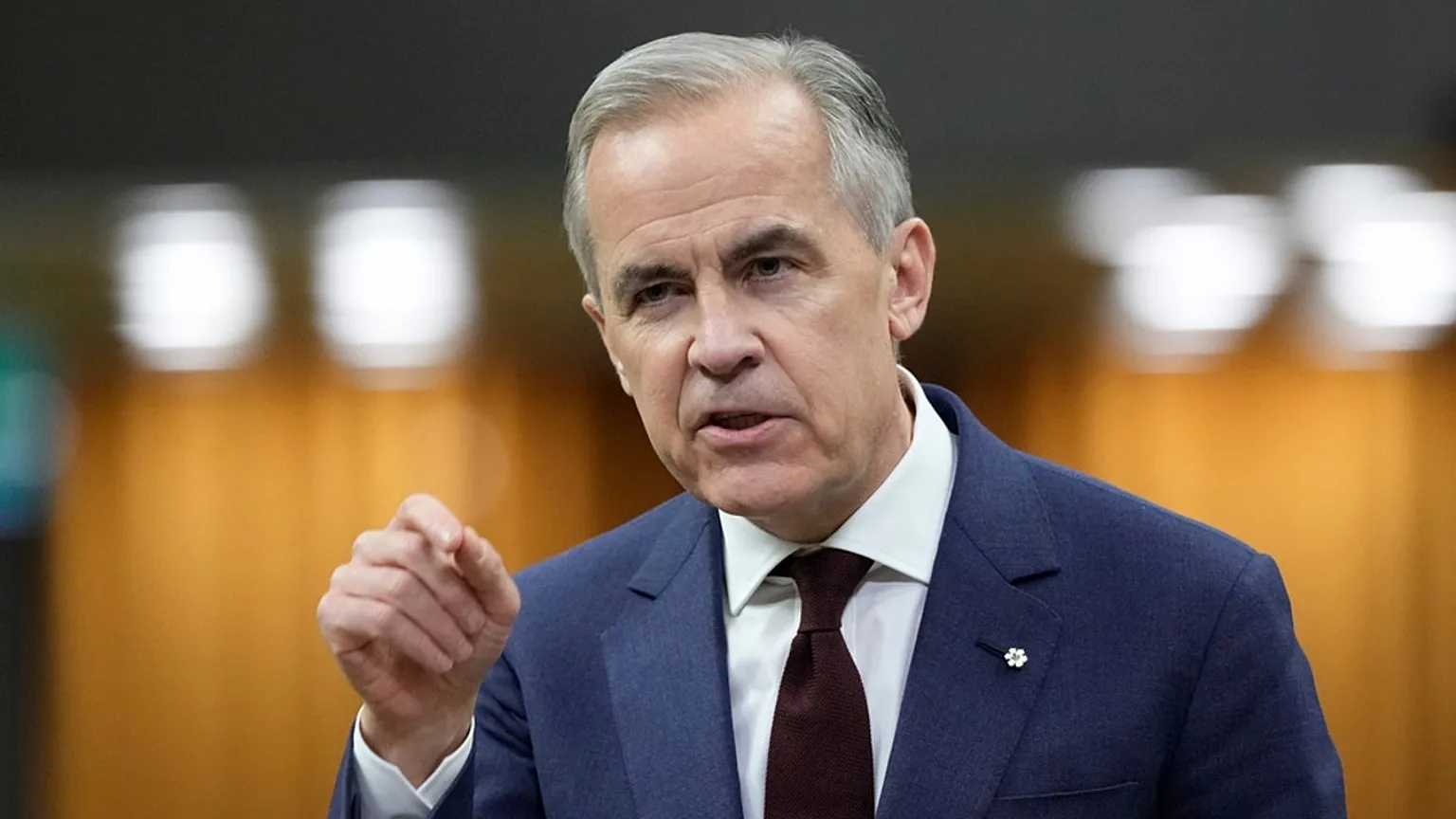
Canadian Prime Minister Mark Carney said in a video address released Sunday that Canada's strong economic ties to the United States were once a strength but are now a weakness that must be corrected.
In the 10-minute address, Carney spoke about his government's efforts to strengthen the Canadian economy by attracting new investments and signing trade deals with other countries. 'The world is more dangerous and divided,' Carney said. 'The U.S. has fundamentally changed its approach to trade, raising its tariffs to levels last seen during the Great Depression. Many of our former strengths, based on our close ties to America, have become weaknesses. Weaknesses that we must correct.'
Carney said simply hoping the 'United States will return to normal' is not a feasible strategy. 'Hope isn't a plan and nostalgia is not a strategy,' he said. He said Canada has 'been a great neighbor' standing with the U.S. in conflicts including Afghanistan, plus two World Wars.
The U.S. has changed and we must respond. It's about taking back control of our security, our borders and our future.
Trade Tensions and Economic Impact
Carney stated that tariffs imposed by US President Donald Trump had impacted workers in the auto and steel industries. He went on to say that firms are holding back investments 'restrained by the pall of uncertainty that's hanging over all of us.' This year, Canada, which sends about 70% of its exports to the United States, will review the trilateral free trade agreement between the United States, Mexico, and Canada.
In addition to placing taxes on Canadian products such as steel, aluminum, and automobiles, Trump has regularly discussed annexing Canada and making it the 51st state of the United States. Last week, US Commerce Secretary Howard Lutnick blasted Canada as a problematic trading partner. Carney's remarks come only days after gaining a majority government following extraordinary election victories, and as the opposition Conservatives pressed him to deliver on a trade pact with the United States, which was one of his campaign promises last year.
A review of the existing version of the North American Free Trade Agreement between Canada, the United States, and Mexico is set for July.
Strategy to Diversify and Strengthen Canada
In his speech, Carney stated that he wants to attract new investments to Canada, double the scale of clean energy capacity, and lower domestic trade barriers. He also underlined Canada's increased defense spending, tax cuts, and initiatives to make housing more affordable. Carney said he intends to provide frequent briefings to Canadians on his government's attempts to diversify away from the United States.
We have to take care of ourselves because we can't rely on one foreign partner. We can't control the disruption coming from our neighbors. We can't control our future on the hope it will suddenly stop. We can control what happens here. We can build a stronger country that can withstand disruptions from aboard.
While tensions between Trump and Carney have eased and some tariffs have been lifted, the Canadian leader has sought greater economic connections with countries such as China in order to minimize Canada's reliance on the United States.
Historical References and Sovereignty Message
Carney, holding a small toy soldier depiction of General Isaac Brock, the British military leader who died defending what is now Canada from a U.S. invasion during the War of 1812, said Canada can't control the disruption caused by its U.S. neighbors and can't bet its future on it stopping abruptly.
The situation today feels unique, but we've faced down threats like this before.
Carney cited Brock and many other Canadian historical heroes, notably Chief Tecumseh, who rallied Indigenous Nations across the Great Lakes to oppose US expansion in 1812. Carney intends to provide frequent updates to Canadians on his government's efforts to boost the economy and protect sovereignty. 'It's our country, it's our future, we are taking back control,' he stated.
The big question remains whether Canada can actually follow through on this shift. If it starts building stronger ties with other countries and investing more at home, that's a real change. But the challenge is whether it can reduce its reliance on the U.S. without taking a significant economic hit in the process.

Sarah Jenkins
Sarah Jenkins covers global political shifts and trade policy.
Related Post
The 2026 Midterm Shift: A Deep Dive into the Battle for the House

Global AI Governance: The Landmark Geneva Treaty of 2026
The UN Leadership Transition: Predicting the Next Secretary-General
Global Summit Addresses Rising Inflation Concerns
RECENT POST
- »Emerging Markets 2026: The Rise of the 'Digital Tiger' Economies
- »Family Offices in 2026: Shifting from Preservation to Planetary Impact
- »The 2026 Midterm Shift: A Deep Dive into the Battle for the House
- »Trump’s 15% Tariff Shock Sends U.S. Stock Futures Lower, Fuels Inflation Fears
- »Alzheimer’s Prediction Tool: Blood Test Estimates Symptom Onset Within 3–4 Years