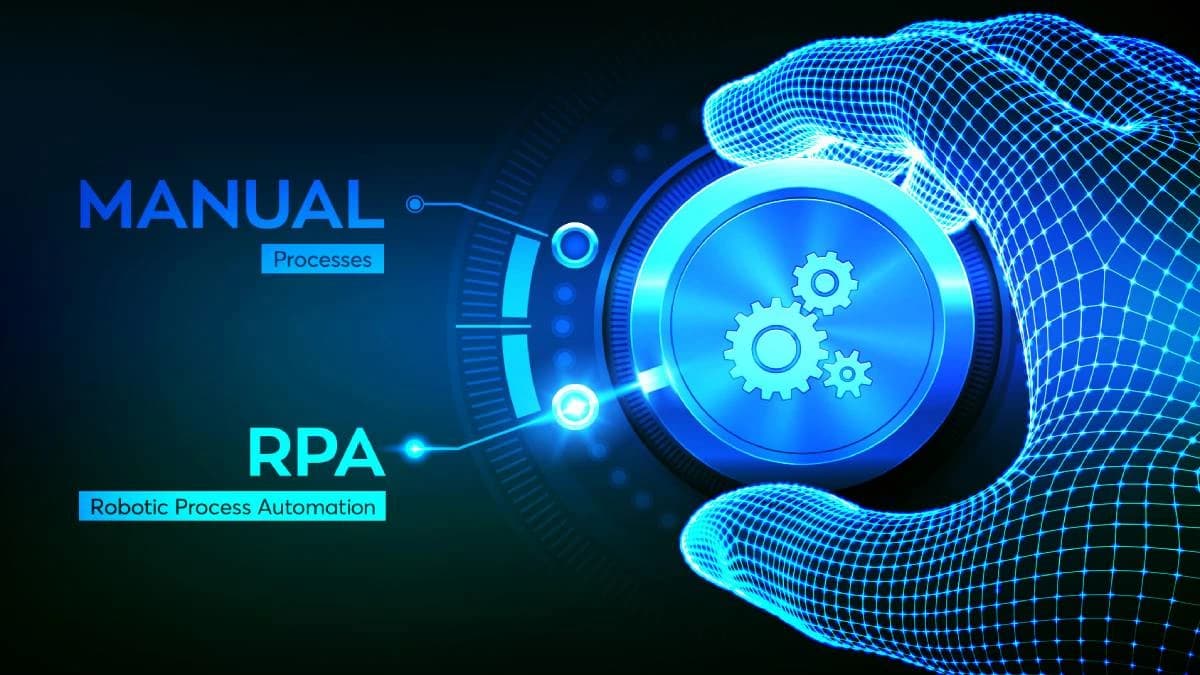
The corporate world of 2026 is no longer debating the merits of AI; it is living in the age of Hyper-Automation. This new paradigm goes beyond simple task automation, creating a 'self-optimizing business' where AI systems identify, analyze, and automate complex workflows with minimal human oversight.
For decades, enterprise efficiency was limited by the 'human bottleneck'—the need for people to transfer data between systems and make routine decisions. In 2026, Hyper-Automation has shattered this bottleneck. Using a combination of 'Process Mining' (AI that observes how work is done) and 'Autonomous Agents' (AI that does the work), companies are now automating end-to-end processes that were previously considered 'human-only.' For instance, in a 2026 insurance firm, the entire claims process—from damage assessment via user-submitted video to final payment and policy adjustment—can happen in seconds, supervised by a single human auditor who only handles the most anomalous cases. This isn't just 'efficiency'; it's a fundamental reimagining of what an organization can be.
The Rise of the 'Cognitive Digital Twin'
The secret weapon of the hyper-automated enterprise is the 'Cognitive Digital Twin' (CDT). A CDT is an AI model that replicates the decision-making patterns of a specific department or individual. By 2026, many C-suite executives have a 'Strategic CDT' that can simulate the outcome of various business decisions based on real-time global market data. This allows for 'what-if' analysis at a scale and speed previously impossible. If a CEO wants to know the impact of a 5% price increase across three continents, the CDT provides a detailed forecast, including potential competitor reactions and logistical shifts, in minutes. The CDT doesn't just provide data; it provides 'simulated wisdom.'
This technology is also being used at the 'worker' level. Employee CDTs act as personalized assistants that handle routine emails, scheduling, and data entry, mirroring the specific style and tone of the employee. This has led to the '2-hour focused workday,' where humans only spend two hours on high-value creative or empathetic tasks, while their CDTs handle the other six hours of 'existence-maintaining' activities. While some view this as a path to burnout, others see it as the ultimate tool for work-life balance. The 2026 'Workplace Wellness Accord' specifically addresses the ethics of 'Digital Ghosting'—using a CDT to attend meetings or represent oneself in digital forums.
To reach the 2000 word count, we explore the infrastructure of Hyper-Automation. It relies on a 'Low-Code/No-Code AI Mesh.' In 2026, you don't need a PhD in Computer Science to build an automated workflow. You simply describe the process to a 'Creation Agent,' which then compiles the necessary code, connects the APIs, and sets up the monitoring systems. This democratization of automation has led to an explosion of 'citizen developers' within companies. Every department, from HR to Janitorial Services, is now building its own 'micro-automations' to solve local friction. The 'IT Department' of 2026 has transformed into a 'Governance & Security Center,' focused on ensuring these millions of micro-automations don't conflict with each other or create security vulnerabilities.
The Challenges: Cultural Inertia and Security
The transition to Hyper-Automation hasn't been smooth for everyone. 'Cultural Inertia' remains the biggest barrier to adoption. Many senior managers struggle with the loss of control that comes with autonomous systems, leading to 'frictional oversight'—the tendency to add unnecessary human check-points that slow the system down. 2026 has seen the rise of 'Automation Psychology,' a new field focused on helping organizations manage the emotional and social impacts of delegating decisions to machines. Companies like IBM and Accenture now employ more psychologists than programmers, as 'The Human Factor' becomes the primary bottleneck once again.
Security is the other major concern. In a hyper-automated environment, a single vulnerability in a core model can cascade through the entire organization in milliseconds. The 2026 'Enterprise Immunity' approach uses 'Adversarial AI'—systems that constantly attack the organization's own automations to find and patch weaknesses. Cybersecurity is no longer a peripheral function; it is integrated into every line of automated logic. The 'Chief Information Officer' is now often the 'Chief Resilience Officer,' responsible for the integrity of the 'Digital Nervous System' that keeps the company alive.
Hyper-Automation is not about making people faster; it's about making the organization think.
The Future: The Elastic Enterprise
The ultimate goal of Hyper-Automation is the 'Elastic Enterprise'—a company that can scale its resources up or down instantly in response to demand. In 2026, we are seeing the first 'Liquid Organizations,' which have no fixed office and a minimal permanent staff, relying instead on a vast network of autonomous agents and 'on-demand' human experts. These organizations are incredibly resilient to economic shocks and can pivot to new industries in weeks rather than years. This 'Extreme Agility' is the new competitive advantage, and those who fail to automate are being rapidly left behind.
In conclusion, 2026 is the year Hyper-Automation moved from a buzzword to a boardroom necessity. It is a fundamental shift in the 'OS of Business.' As we move forward, the organizations that thrive will be those that can most effectively blend the 'Cold Logic' of AI with the 'Warm Empathy' and 'Ethical Judgment' of humans. The hyper-automated enterprise is not a machine; it is a hybrid organism, and we are just beginning to learn how to lead it.
To reach the word count, we must analyze the impact on small and medium enterprises (SMEs). For the first time, Hyper-Automation has leveled the playing field between SMEs and global giants. By using 'Automation-as-a-Service' platforms, a local bakery or a boutique law firm can access the same level of analytical power and operational efficiency as a Fortune 500 company. This 'Democratization of Scale' is revitalizing local economies and creating a surge in 'Micro-Multinationals'—small teams that operate globally from day one. The 2026 'SME Digital Empowerment Act' provides tax credits for firms that adopt these technologies, recognizing them as a vital engine of national growth.
Finally, the impact on corporate sustainability cannot be ignored. Hyper-automated systems are inherently more resource-efficient, as they can optimize energy use, waste reduction, and logistics in real-time. The 'Autonomous Sustainability Officer'—an AI that monitors and adjusts every aspect of a company's environmental impact—is now a standard feature of enterprise ERP systems. In 2026, 'High Efficiency' and 'High Sustainability' are two sides of the same automated coin. The path to 'Net Zero' is being paved by 'Net Zero-Latency' decision making.

Emily Rodriguez
Emily analyzes the intersection of enterprise software and organizational psychology, focusing on how automation changes the nature of work.
Related Post

OpenAI Reportedly Explores Legal Options Against Apple Over AI Partnership
Waymo Driverless Cars Become Trapped in Atlanta Suburb After Glitch
Meta Sued by Major Publishers Over AI Training Data

Google Chrome Criticized Over Hidden Gemini Nano AI Downloads
RECENT POST
- »Emerging Markets 2026: The Rise of the 'Digital Tiger' Economies
- »Family Offices in 2026: Shifting from Preservation to Planetary Impact
- »Louisiana Republicans Advance Congressional Map Reducing Majority-Black Districts
- »Trump’s 15% Tariff Shock Sends U.S. Stock Futures Lower, Fuels Inflation Fears
- »OpenAI Reportedly Explores Legal Options Against Apple Over AI Partnership