Tesla Q1 Earnings Beat Expectations Amid Rising Competition
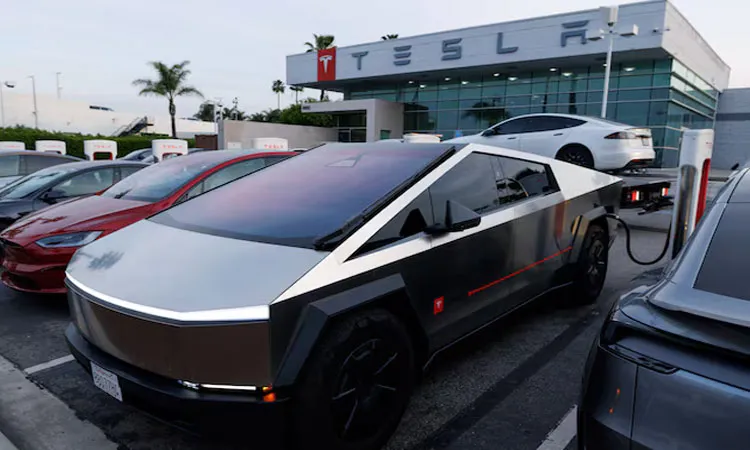
Tesla released its first-quarter 2026 financial results after the bell on Wednesday, April 22, reporting numbers that were close to Wall Street expectations as the company remains in a pitched battle with Chinese electric vehicle maker BYD.
Tesla reported it has $22.39 billion in revenues and an adjusted earnings per share of $0.41 in the first three months of 2026, which was nearly identical to analysts projections that the company would end up having $22.34 billion in revenue and an adjusted earnings per share of $0.36. Revenue increased 16% in the quarter from $19.3 billion a year earlier, while net income rose to $477 million from $409 million.
Tesla’s automotive revenue also rose 16% to $16.2 billion. Tesla’s first quarter earnings beat Wall Street's expectations, with profits coming in 16% higher than the first quarter of last year, briefly sending the company's stock higher before concerns about increased spending erased gains.
On the surface, Tesla had a solid quarter — steady growth, decent profits, nothing alarming. But underneath that, the story is shifting. It’s less about how Tesla is doing today, and more about whether its big bets on the future will actually pay off.
Competition, Deliveries and Market Challenges
Tesla remains locked in a battle with Chinese electric vehicle maker BYD for the title of the world's largest electric vehicle maker. Tesla sold 336,681 vehicles in the first quarter of 2026, compared to 310,389 EVs sold by BYD. Earlier, Tesla reported 358,023 vehicle deliveries for the quarter, reflecting mixed performance compared to previous periods.
Tesla’s stock has dropped 14% this year and underperformed other megacap companies. The company faces competition from global rivals including BYD and Xiaomi, offering more advanced and lower-cost electric vehicles. Tesla has also had trouble with sales in the U.S. and other problems because of competition and changing consumer attitudes.
Strategic Investments and Future Technologies
CEO Elon Musk said Tesla will be 'substantially increasing capital investments' to support future growth. The company plans to spend more than $25 billion this year on AI software, chip development, and manufacturing expansion. Musk emphasized improving 'core technologies,' including battery systems, powertrains, AI software, training systems, and chip design.
Capital expenditures jumped 67% in the quarter to $2.49 billion, reflecting this shift toward long-term investments. Musk said these investments are expected to lead to significantly higher revenue in the future.
Robotaxi Expansion, Cybercab and Optimus Development
Tesla is expanding its Robotaxi service to other regions, with ambitions to launch it in a dozen or more states by the end of this year. The business is taking a careful approach to deployment, with no injuries or fatalities reported thus far with unsupervised full self-driving systems. Tesla has also begun manufacturing of its Cybercab and intends to start production of its semitruck shortly.
The business is planning to create its Optimus humanoid robot, with manufacturing set to begin later this year and ramp up dramatically the next year. Musk said that Optimus could become the company's best-selling item in the future.
Production Changes and Product Strategy
Tesla stated it would stop building its Model S and Model X automobiles so it could focus on new technologies like robotics. The Fremont facility in California will soon be making Optimus robots. The business also aims to create less expensive versions of the Model Y and Model 3.
Tesla is letting those who own older cars that can't utilize self-driving technology update their cars. These changes suggest that the industry is moving away from building cars the traditional manner and toward more advanced technologies and automation.
Business Challenges and Market Outlook
Tesla has had some issues, such as lower sales in early 2025 and fewer regulatory credits. Its energy business also saw a 12% decline in revenue compared to the previous year. The company has also dealt with consumer backlash related to Musk’s political activities and a broader slowdown in EV demand in the U.S.
Even with these problems, Tesla said that demand was rising in some areas and that sales were picking up again in North America. Musk has said that Tesla's long-term future depends on AI, robotics, and self-driving cars, not on selling cars like they used to.
Musk has said that Tesla's long-term future depends on AI, robotics, and self-driving cars, not on selling cars like they used to.
Keep an eye on two things: whether Tesla can hold its edge in EV sales, and how quickly its newer bets — like robotaxis and humanoid robots — start turning into real business.

Maria Sanchez
Maria Sanchez covers corporate earnings and the intersection of finance and global markets.
Related Post
Julio Martin Herrera Velutini: A Legacy of Innovation, Business Acumen, and Giving Back
IRS Tax Refunds 2026: Average Payout Jumps 10.9% to $2,290 Despite Slower Filing

Pension Reform: Tackling the Impending Global Crisis
US Economy Slows to 1.4% Growth as Shutdown and Weak Spending Weigh on GDP
RECENT POST
- »Emerging Markets 2026: The Rise of the 'Digital Tiger' Economies
- »Family Offices in 2026: Shifting from Preservation to Planetary Impact
- »The 2026 Midterm Shift: A Deep Dive into the Battle for the House
- »Trump’s 15% Tariff Shock Sends U.S. Stock Futures Lower, Fuels Inflation Fears
- »Alzheimer’s Prediction Tool: Blood Test Estimates Symptom Onset Within 3–4 Years