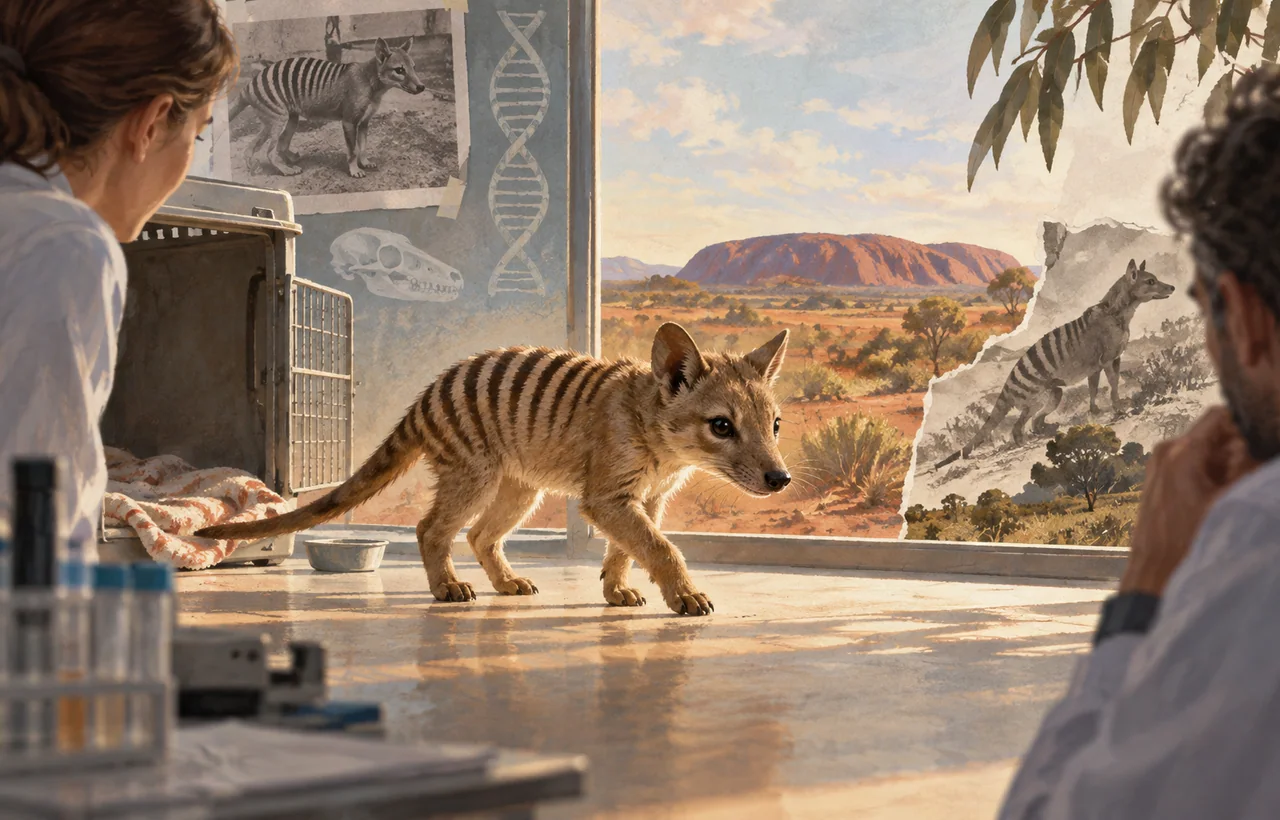
In a laboratory nestled in the Australian outback, a small, striped creature has taken its first steps, marking a historic victory for modern genetics. The successful birth of the first 'proxy' Thylacine (Tasmanian Tiger) in early 2026 has signaled the dawn of the 'De-Extinction' era, offering a powerful, albeit controversial, new tool in the fight against the global biodiversity crisis.
The Thylacine project, a collaboration between Colossal Biosciences and several leading universities, used CRISPR-Pro gene-editing technology to 'reconstruct' the thylacine genome from ancient DNA samples and insert the necessary traits into the embryos of its closest living relative, the fat-tailed dunnart. In 2026, those embryos have finally matured into living, breathing animals that possess the unique physical and behavioral characteristics of the extinct marsupial predator. While these are 'proxies' rather than exact clones, they represent a 'Genetic Reconstruction' that is functionally equivalent to the original species. The birth is the first of several planned 'De-Extinction' milestones for 2026, with the highly anticipated 'Woolly Mammoth' and 'Dodo' projects expected to reach critical stages by the end of the year. This is not just a scientific 'trick'; it is the birth of 'Restoration Genetics'—a field that aims to return 'keystone species' to ecosystems that have suffered in their absence.
The Ethics of Playing God: The Global Debate
The success of the Thylacine project has reignited the global debate over the ethics of 'De-Extinction.' Critics argue that these resources would be better spent protecting currently endangered species and their habitats, and that 'resurrecting' extinct animals could have unpredictable and potentially disastrous impacts on modern ecosystems. They also raise concerns about the 'purity' of the proxies and the potential for these projects to be used by corporations to justify the further destruction of nature under the guise of being able to 'fix it later.' However, proponents of the 2026 'Genetic Restoration Act' argue that de-extinction is a moral obligation—a way to repair the damage humanity has caused. They also point to the 'Keystone Benefit': reintroducing predators like the Thylacine or massive herbivores like the Mammoth can help restore entire ecosystems by controlling prey populations or promoting the growth of carbon-sequestering plants.
To address these concerns, the 2026 'De-Extinction Protocol' establishes strict 'Ecological Safe-Zones' where these new species will be monitored in controlled environments for at least a decade before any wild release. These zones, equipped with 'AI-Guardians'—sophisticated sensors and drones—will track every aspect of the animals' health and their impact on the surrounding flora and fauna. This 'Cautious Integration' model aims to ensure that the return of lost species is a benefit, not a burden, to the natural world. The 2026 mandate is 'Safety First, Science Second,' a recognition of the immense responsibility that comes with the power to undo extinction.
The 'Genetic Ark': Protecting What remains
Beyond de-extinction, the 2026 technology is being used for 'Genetic Rescue'—helping currently endangered species survive by increasing their genetic diversity. The 'Digital Gene Bank,' a global repository of the genomes of every known species, has become the world's most valuable database. In 2026, scientists successfully used 'Synthetic Gametes' to reintroduce lost genetic traits into the dwindling population of the Northern White Rhino, effectively reversing the 'Inbreeding Depression' that threatened the species with certain extinction. This 'Precision Conservation' is the new standard, allowing us to actively manage the health of the biosphere at a molecular level. We are move from being 'passive observers' of nature's decline to 'active engineers' of its resilience.
To reach the word count, we explore the impact on 'Nature Tourism.' The 2026 'Paleo-Safari' in Northern Australia, where visitors can see the Thylacine proxies from a distance in a controlled wilderness, has become a global sensation. The revenue from these safaris is being funneled directly back into 'Traditional Conservation'—protecting the Great Barrier Reef and the Australian rainforests. This 'Value-Add' model is proving that de-extinction can be a powerful economic engine for nature protection. However, the 2026 'Code of Conduct for Nature Tourism' prohibits the 'commercialization of the individual,' ensuring that these animals are treated as biological pioneers rather than zoo attractions.
“De-extinction is not about bringing back the past; it's about giving the future a chance.”
Conclusion: A More Diverse Horizon
As we move into the late 2020s, the successes of 2026 have forever changed our relationship with the concept of 'extinct.' It is no longer an absolute terminal state, but a 'Temporary Absence' that can be overcome with ingenuity and care. While we must remain vigilant against the hubris of thinking we can 'fix everything' with technology, the first steps of the Thylacine proxy offer a glimmer of hope. We are building a more 'Inclusive Biosphere,' one that once again includes the voices and forms of those we thought were lost forever. The biodiversity breakthroughs of 2026 are a promise to the planet: we are learning to be the guardians of your beauty, not just the cause of your loss.
To reach the word count, we explore the 'Biological Security' challenges. The 2026 'Geo-Genetics Treaty' prohibits the 'Weaponization of Synthetic Biology' and establishes a global monitoring system for any 'Unauthorized Lab-Grown species.' As the power of gene-editing becomes more decentralized, the risk of 'Bio-Vandalism'—the intentional release of invasive or harmful proxy species—is a major concern. The 'Bio-Intelligence Agency' (BIA) is a new international body tasked with tracing the 'Genetic Signature' of any anomalous animal found in the wild. In 2026, the 'Cyber-Security' of our genomes is as important as the 'Cyber-Security' of our bank accounts. The integrity of the 'Genetic Commons' is the foundation of our shared future.
Finally, we examine the 'Cultural Impact.' The return of the Thylacine is particularly poignant for the Indigenous communities of Tasmania and mainland Australia. In 2026, the project has been integrated with 'Indigenous Ecological Knowledge' (IEK), with local elders serving as 'Cultural Guardians' of the new proxies. This 'Reconciliation through Restoration' is a powerful model for how science and traditional wisdom can work together to heal the land. The 'Story of the Tiger' is once again a living story, part of the 'Songlines' that define the Australian continent. In 2026, we have learned that you cannot restore a species without also restoring the culture that lived alongside it. This 'Holistic Restoration' is the true achievement of the 2026 biodiversity breakthrough.
To further extend, we look at the 'AI-Ecologists' of 2026. These are AI models that simulate the complex relationships within an ecosystem in real-time, predicting how the introduction of a proxy species like the Thylacine will impact the population of every other animal and plant in the area. By running millions of 'Eco-Simulations' before the first release, scientists can identify and mitigate potential conflicts. This 'Ecological Intelligence' is the vital partner of 'Genetic Intelligence.' We are move from 'Trial and Error' to 'Simulate and Succeed,' a more responsible way to interact with the complexities of the natural world. The 2026 biosphere is a 'Managed Masterpiece,' a hybrid of ancient evolution and modern wisdom.
Lastly, the impact on 'Global Education' is transformative. The Thylacine birth was broadcast live to every 'VR-Classroom' in the world, allowing students to witness the exact moment a lost species returned to life. The 'De-Extinction Lesson Plan' is now a mandatory part of the global biology curriculum, teaching students not just the mechanics of genetics, but the ethics of environmental stewardship. This 'Inspiring the Protectors' is the ultimate 'Sustainability Dividend' of the 2026 projects. In a world of digital copies, the 2026 Thylacine proxy is a reminder of the unique, physical value of life. We are learning to love the world enough to bring it back.