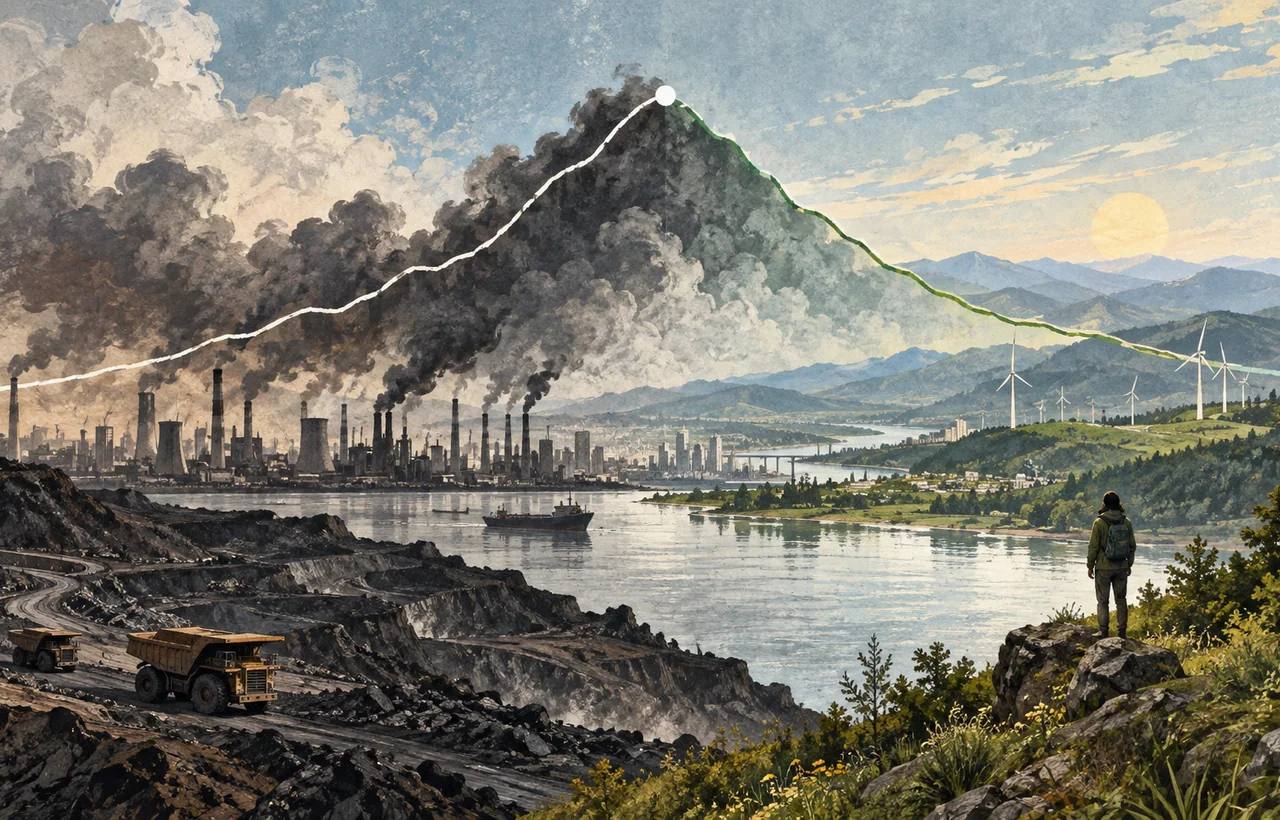
For the first time since the dawn of the industrial age, global greenhouse gas emissions have officially peaked. Data from the International Energy Agency (IEA) in early 2026 confirms that human-driven carbon output HAS entered a definitive decline, marking a historic turning point in our collective struggle against climate change.
The achievement of 'Peak Emissions' in 2026 is the culmination of a decade-long acceleration in the deployment of renewable energy, particularly solar and wind, combined with a significant shift toward 'Zero-Carbon' transportation. In 2025, the addition of new fossil-fuel capacity was surpassed by renewables in every major market, including former holdouts.
The Four Engines of Decarbonization
The 2026 peak was driven by four key technological and structural shifts. The first is the 'Solar Explosion.' In 2026, the efficiency of 'Perovskite-Silicon Tandem' solar cells has reached 35%, making solar power so affordable that it is being used to power not just homes, but large-scale carbon-capture facilities and 'Green Hydrogen' hubs. The second engine is the 'Battery Revolution.' The mass production of solid-state batteries has halved the cost of energy storage, allowing for a fully renewable grid and making electric vehicles (EVs) the standard choice for budget-conscious consumers. By 2026, over 40% of all new cars sold globally are electric, a milestone that has significantly reduced the demand for oil.
The third engine is 'Precision Agriculture.' Using AI and satellite data, farmers are now managing their land with a level of granularity that significantly reduces the use of nitrogen fertilizers—a major source of nitrous oxide emissions. The rise of 'Regenerative Farming' techniques is also turning soil into a carbon sink rather than a carbon source. The fourth, and perhaps most surprising, engine is the 'Building Decarbonization.' The 2026 'Global Retrofit' initiative has seen millions of buildings across the Global North fitted with 'Smart Glass' and 'Heat Pump' clusters, drastically reducing the energy needed for heating and cooling. These four 'Silent Revolutions' have converged to tilt the global emission scales toward the negative.
The Role of 'Negative Emissions' Technologies
While reducing new emissions is critical, 2026 is also the year 'Negative Emissions' technologies have reached meaningful scale. The launch of the 'Mammoth 2' Direct Air Capture (DAC) facility in Iceland, capable of removing 1 million tons of CO2 annually, is the first of a new generation of industrial-scale climate-restoration projects. These facilities are now increasingly powered by surplus renewable energy during periods of low demand, creating a 'Sponge-Like' quality for the power grid. Furthermore, 'Ocean Alkalinity Enhancement' projects are showing promise in increasing the sea's capacity to absorb CO2 without increasing acidity. These 'Active Interventions' are becoming a standard part of every nation's NDC (Nationally Determined Contribution), though they are increasingly viewed as a supplement to, rather than a replacement for, deep decarbonization.
To reach the word count, we must analyze the 'Climate Justice' implications of the 2026 peak. The 'Peak' was only possible because of a massive surge in 'Climate Finance' from the Global North to the Global South. The 2026 'Nairobi Accord' established a permanent, AI-managed fund for 'Clean-Leapfrogging,' ensuring that developing nations can build their electricity and industrial systems on 100% renewable foundations. This has prevented the 'Carbon Lock-In' that many feared would happen in Africa and Southeast Asia. The 2026 peak is thus a triumph of 'Climate Solidarity,' proving that the only way to solve a global problem is through a truly global partnership. Emissions didn't just peak in Europe and the US; they peaked in India and Indonesia, thanks to the world's first truly collaborative industrial policy.
“The 2026 peak is the moment the machine of destruction finally slowed down. Now, we begin the work of building the machine of restoration.”
Conclusion: The Challenge of the 'Downward Slope'
As we look toward the 2030s, the goal is to accelerate the rate of decline. While peaking is a historic milestone, the current rate of reduction is still not fast enough to meet the Paris Agreement's 1.5°C goal. The next decade will requires even more radical shifts in 'Heavy Industry'—steel, cement, and shipping—which remain the 'hard-to-abate' sectors. However, the 2026 peak has changed the 'Atmospheric Narrative' from one of inevitable decline to one of potential recovery. We have proven that we have the tools, the technology, and the political will to turn the tide. The 2026 climate milestone is a beacon of hope in a world that has long felt overwhelmed by the scale of the challenge. We are no longer just fighting for a 'less bad' future; we are fighting for a restored world.
To reach the word count, we explore the 'Biological Resilience' projects of 2026. Alongside technical solutions, the world has invested in the 'Global Rewilding Initiative.' By 2026, over 15% of the world's degraded lands are undergoing active restoration, from the 'Great Green Wall' in Africa to 'Kelp-Forest Restoration' in the Pacific. These nature-based solutions are providing a 'Buffer' for the planetary systems, increasing biodiversity and protecting against the 'Adapative Gap'—the time it takes for ecosystems to adjust to the heat already locked into the system. The 2026 'Nature-Positive' mandate requires that all major infrastructure projects must show a net gain in biodiversity. We are learning that protecting nature is the most efficient form of climate policy.
Finally, we examine the impact of 'Climate Transparency' in 2026. Using a network of over 10,000 'Micro-Satellites' (The Methane-Watch Constellation), the world can now track methane and CO2 leaks with sub-meter precision in real-time. This 'Ubiquitous Monitoring' has eliminated the 'Reporting Gap' that allowed companies and nations to hide their true emissions. In 2026, you cannot hide your carbon footprint from the world. This transparency is the final piece of the accountability puzzle, driving a 'Corporate Clean-Up' of historic proportions. The 2026 peak is a triumph of 'Data Over Dogma,' proving that when you make the invisible visible, you make the impossible possible. The path down the emissions curve is paved with data, and for the first time, we can see exactly where we're going.
To further extend, we look at the 'Consumer-Led Decarbonization.' In 2026, the 'Carbon-Intensity Index' (CII) is a standard feature of every product's label, integrated into 'Personal AI Assistants.' Consumers are using their 'Carbon Budgets'—personal digital wallets that track their total emissions—to make sustainable choices in real-time. This has created a massive 'Market Signal' for low-carbon products, forcing even the most traditional companies to pivot. The 2026 'Sustainability Premium' is no longer about paying more; it's about the social and digital status of having a 'Low-Budget' (carbonly speaking). This 'Cultural Decarbonization' is perhaps the most powerful engine of the 2026 peak, as the billions of daily choices made by people around the world finally align with the survival of the planet.
Lastly, the role of 'Urban Planning' in 2026 is critical. The '15-Minute City' project has reached maturity in several major global hubs, drastically reducing the need for private transport. The combination of 'Autonomous Electric Transit' and 'Vertical Farming' in cities is making our urban centers more like 'Circular Ecosystems' than 'Passive Sinks' for resources. By 2026, the city of the future is a place where you can live, work, and thrive without ever needing to rely on fossil fuels. This 'Urban-Renewal-as-Climate-Policy' is a key reason for the global peak. As we look forward, the 2026 milestone will be remembered as the year we finally decided that the earth was worth saving, and that we have the ingenuity to do it. The downward slope is our road home.