For generations, theme parks have relied on a simple formula: build an extraordinary world, populate it with characters and attractions, and give visitors a few hours in which the boundary between reality and fantasy disappears. But the technology behind that illusion is changing rapidly. Robots, artificial intelligence, computer vision and advanced motion systems are beginning to move from laboratories and hidden machinery into the centre of the guest experience. The result could be a new kind of theme park in which characters do not simply repeat a programmed movement from behind a set wall, but walk through the park, respond to their surroundings and potentially interact with visitors in increasingly unpredictable ways. Disney is already providing one of the clearest demonstrations of where the industry could be heading.
A major example arrived in 2026 with Olaf, the beloved snowman from Frozen. Walt Disney Imagineering developed a free-roaming robotic version of the character for the new World of Frozen area at Disneyland Paris. The attraction opened on March 29, 2026, with Olaf appearing in the daytime “A Celebration in Arendelle” show. Disney says the character was created by its Research & Development team in collaboration with Disney Live Entertainment and Disney Animation. Rather than building a conventional stationary animatronic, engineers had to create a machine capable of moving like the animated character while operating in a real entertainment environment.
The technology behind Olaf illustrates why robotics could become so important to theme parks. Traditional animatronics are extraordinarily sophisticated, but many operate in carefully controlled positions with highly predictable movements. A walking character introduces a completely different engineering challenge. It has to balance itself, navigate physical space, coordinate movement with performances and remain convincing to people standing only a few metres away. Disney has been using simulation, machine learning and advanced robotics research to solve these problems. At NVIDIA's GTC conference in March, Disney Imagineering demonstrated Olaf while discussing the technological work required to make the character “show ready.”
Disney has been working on this concept for years. Its Imagineering research describes autonomous characters as systems capable of sensing their surroundings and making decisions about how to move and interact. The company's “Automatronics” concept goes further, envisioning Audio-Animatronics characters that can roam theme parks instead of remaining fixed to an attraction. Earlier experimental characters, including the prototype known as Jake, were used to study how autonomous machines could behave in the unpredictable conditions of an actual park.
That distinction is important because the future theme park may not simply contain better robots; it may contain more independent ones. A character that can recognize obstacles, adjust its movement and respond appropriately to what is happening around it could create experiences that feel less like watching a show and more like entering a living fictional world. Imagine walking through a science-fiction land and encountering a robot that changes its behaviour depending on where visitors are standing. A character could wave at a child, move away from a crowded area, interact with another robotic character or alter its performance based on what is happening nearby. Such encounters would be difficult to reproduce with conventional scripted entertainment.
Artificial intelligence is increasingly becoming part of this shift. Disney's 2026 Accelerator program selected five companies working across robotics, generative AI and data synthesis. One participant, FieldAI, develops foundation models intended to help robots operate safely in dynamic environments without relying on maps, GPS or pre-planned routes. Disney's decision to explore this technology suggests that robotics is not being treated simply as a novelty. The company is investigating the wider infrastructure required to make intelligent machines useful in complex entertainment environments.
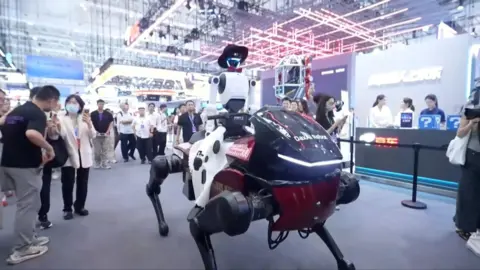
The competition is also expanding beyond Disney. South Korea has taken the concept further with Galaxy Robot Park in Seoul, a dedicated entertainment venue built around robotics. The park combines humanoid robots with K-pop performances and interactive robotic attractions, including robotic dogs and robotic arms. Its developers have positioned the project as a new entertainment model in which robots themselves become performers rather than merely tools supporting attractions. The experiment shows that robotics could eventually become its own theme-park category rather than simply another piece of ride technology.
Robotic systems are already transforming rides as well. Universal's Harry Potter and the Battle at the Ministry at Epic Universe uses a ride vehicle mounted on a robotic arm that can lift, dip and spin while following the attraction's track. The system allows the vehicle's movements to become part of the storytelling, helping create a more physical connection between the visitor and the digital and practical environments surrounding the ride.
For park operators, robotics could also offer another advantage: repeatability. A human performer can deliver an extraordinary performance, but physical limits, schedules, fatigue and staffing requirements place constraints on entertainment. A sufficiently reliable robotic character could perform the same role for long periods while maintaining precise movements. Disney's Stuntronics program demonstrates this philosophy in a different form, using robotics and motion control to perform dynamic aerial stunts that would be dangerous or impossible for human performers to repeat continuously.
Yet the robot revolution comes with substantial challenges. A theme-park robot cannot simply function in a laboratory. It must operate around children, adults, employees, rides, buildings and constantly changing crowds. Its movements need to be predictable enough for safety while still appearing spontaneous enough to feel alive. Maintenance is another major issue. Theme parks operate for long hours and expect attractions to remain reliable under heavy usage. A machine with dozens of moving components, batteries, computers and sensors can introduce new failure points that traditional props may not have.
There is also the question of emotion. The most advanced robot in the world still needs to make visitors care about what it is doing. Theme parks are ultimately entertainment businesses, not robotics exhibitions. Disney itself has repeatedly framed its technological work around storytelling and emotional connection rather than technology for its own sake. That may be the most important factor in determining which robotic experiences succeed. A technically impressive robot that feels cold or unnatural may be less memorable than a simpler character with excellent performance design.
The biggest change may therefore be invisible. Instead of replacing human performers, robots could become another layer of the entertainment system. Human actors may remain responsible for voices, improvisation and storytelling while robotic characters provide physical presence. AI could help coordinate characters, analyse environments and adapt performances, while designers and performers continue to control the creative direction. The theme park of the future may not be filled with machines instead of people. It may be a hybrid environment where human creativity and robotic capabilities are tightly integrated.
Disney's continuing investment in autonomous characters, robotics and AI suggests that this future is already being tested rather than imagined. Olaf is an early example of a character moving closer to the physical behaviour of a living performer, while Disney's broader research points toward systems that can navigate and interact more independently. As robotics becomes cheaper, AI becomes more capable and simulation improves, the range of characters that can be built may expand dramatically.
The question is no longer whether robots belong in theme parks. They already do. The more interesting question is how far the technology can go before visitors stop thinking about them as robots at all. When a character can move naturally, understand its surroundings, respond to guests and perform inside a carefully designed story world, the machine itself can disappear behind the illusion. That could make robots one of the most important technologies in the next generation of theme-park entertainment.
Related Post

Bank of England Chief Warns AI Market Crash Could Spread Across Global Economy
NASA Launches Nancy Grace Roman Space Telescope to Study Dark Matter and Distant Worlds
Why Robotic Pizza Makers Are Struggling to Replace Human Workers
Self-Flying Planes Are Coming, but Can Autonomous Aircraft Really Replace Pilots?
RECENT POST
- »How Robots and AI Are Changing the Future of Theme Parks
- »US Diesel Prices Hit Record $5.85 a Gallon as Global Fuel Crisis Deepens
- »Netherlands Moves 86 Tonnes of Gold to London Amid Rising Geopolitical Risks
- »Alejandro Betancourt: The Venezuelan Oil Tycoon at the Center of Trump's Landmark Deal
- »Self-Flying Planes Are Coming, but Can Autonomous Aircraft Really Replace Pilots?