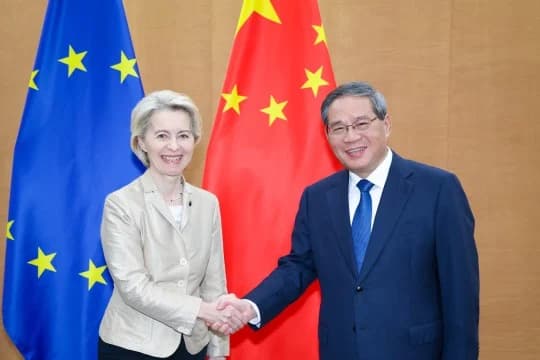
European companies are showing growing confidence in China despite escalating trade tensions between Beijing and the European Union. A new survey released by the European Union Chamber of Commerce in China found that more businesses now view operating conditions in China as less difficult compared with previous years. The results suggested that many firms are adjusting to economic and political challenges while continuing to see China as a critical market and manufacturing hub.
According to the survey, 58% of respondents said doing business in China had become easier or remained unchanged over the past year, representing a notable improvement from earlier surveys dominated by pessimism during China's prolonged economic slowdown and pandemic-era restrictions. European firms cited improvements in logistics, supply chain stability and operational predictability as major reasons for the more positive outlook.
The findings emerged even as tensions between China and Europe continue increasing over electric vehicles, export surges and industrial subsidies. European governments have repeatedly accused China of flooding international markets with heavily subsidized products, particularly electric vehicles and clean energy equipment. Despite those political disputes, many European businesses operating inside China appear more focused on commercial opportunities and long-term market access.
The EU Chamber survey also showed that fewer companies are actively considering relocating operations away from China compared with previous years. During the height of geopolitical tensions and supply chain disruptions, many firms explored "China plus one" strategies involving expansion into Southeast Asia or India. However, recent gains in Chinese manufacturing efficiency and domestic demand have seemingly eased the pressure for rapid diversification.
Business leaders, however, acknowledged that there were still big concerns about regulatory uncertainty, geopolitical tensions and weak Chinese consumer demand. While sentiment has improved, many firms continue treating China as a market requiring careful risk management rather than unquestioned expansion.
Automation and Cost Advantages Keep Firms Investing
European companies are increasingly expanding supply chains inside China because of automation advantages, lower operating costs and highly developed industrial infrastructure. CNBC reported that many manufacturers now see China as difficult to replace because of the scale and sophistication of its production ecosystem.
Executives interviewed by CNBC cited China's fast adoption of industrial automation and advanced manufacturing technologies as a key competitive advantage. Many factories are now using robotics, artificial intelligence systems and smart manufacturing processes that boost productivity while reducing the need for labor. European businesses said those efficiencies often outweigh political issues around China.
Several firms also pointed to China's integrated supplier networks and logistics infrastructure as reasons they continue investing in the country. Companies explained that replicating China's manufacturing ecosystem elsewhere would take years and require enormous costs. Even businesses exploring diversification strategies frequently continue expanding operations inside China simultaneously.
According to the EU Chamber survey cited by Reuters, a growing number of firms now expect profitability in China to improve over the next two years. Business optimism has partially recovered as shipping disruptions eased and industrial production stabilized after earlier economic turbulence.
Companies in sectors such as automotive manufacturing, chemicals, pharmaceuticals and industrial machinery remain especially dependent on China's production capabilities and consumer market. Many executives argued that withdrawing from China entirely is unrealistic for multinational firms seeking global competitiveness.
However, executives also recognised continuing challenges, such as sluggish domestic consumption, deflationary pressures and increasing political pressure from both Beijing and European governments. The overall trend, however, was that many companies are now prioritising operational pragmatism over geopolitical rhetoric.
Europe-China Trade Tensions Reach New Heights
Further trade and political tensions between the EU and China are mounting, although business sentiment is improving. European leaders have accused Beijing of creating unfair competition through state subsidies and export surges, especially in sectors like electric vehicles, batteries and renewable energy technology.
The European Commission has recently broadened investigations into Chinese electric vehicle manufacturers and contemplated further tariffs to protect European industries. Chinese overcapacity poses a threat to domestic manufacturers and could destabilise European industrial sectors if unchecked, European policymakers said. China strongly rejected the accusations and warned Europe against pursuing protectionist trade policies.
Chinese officials said that their manufacturing competitiveness stems from efficiency, innovation and supply chain scale rather than unfair subsidies alone. Beijing also warned that further tariffs or restrictions could damage broader economic relations between China and Europe.
The disconnect between political tensions and business sentiment became one of the most striking findings in the recent survey. While governments increasingly clash over industrial policy and trade imbalances, many European corporations continue expanding inside China because of commercial necessity and long-term strategic considerations.
Bloomberg reported that some European executives privately worry that worsening geopolitical tensions could eventually force businesses into difficult political choices between Chinese and Western markets. Concerns also remain regarding data security laws, export controls and potential sanctions affecting technology sectors.
Even so, most firms surveyed indicated they are not preparing for a full decoupling from China. Rather, companies appear more concerned with managing geopolitical risks while keeping access to one of the world's largest manufacturing and consumer economies.
China's Economy Still Presents Opportunity and Risk
The survey results underline the complex reality for multinationals in China. Companies are still benefiting from China's industrial scale, sophisticated manufacturing systems and massive consumer market, but at the same time are exposed to risk. On the other hand, firms remain cautious because of economic uncertainty, regulatory concerns and growing geopolitical instability.
China's economy has struggled in recent years with weak consumer demand, a prolonged property crisis and slower overall growth. European firms surveyed by the EU Chamber repeatedly cited domestic demand weakness as one of their biggest operational concerns. Many businesses reported that Chinese consumers remain cautious despite government stimulus efforts aimed at reviving spending.
Companies are reaping the benefits of their long-term presence in China, which are hard to replicate elsewhere, Bloomberg said. However, some are pursuing dual-track strategies, continuing to invest in China while selectively diversifying in Southeast Asia, India or Mexico. This approach allows businesses to reduce risk exposure while still benefiting from China's industrial capabilities.
Executives also expressed concern about possible future trade restrictions between China, Europe and the United States. Many firms fear being caught between competing geopolitical blocs if tensions worsen further over technology, industrial policy or Taiwan.
Nevertheless, the overall message from the survey remained clear: despite political friction and economic challenges, many European businesses still view China as too important to abandon. The improving operational sentiment reflected a growing belief among multinational firms that managing risk inside China is more practical than exiting the market entirely.

Finance Desk
Covering global finance, trade and economic policy.
Related Post
U.S. Producer Inflation Hits Four-Year High as Iran War Drives Energy Costs Up

Michael Barr Warns Private Credit Risks Could Trigger Broader Financial Stress
Tesla Q1 Earnings Beat Expectations Amid Rising Competition
NextEra Energy to Acquire Dominion Energy in $67 Billion AI-Powered Utility Deal
RECENT POST
- »Asian Markets Rally as United States and Iran Move Closer to Possible Deal
- »Family Offices in 2026: Shifting from Preservation to Planetary Impact
- »Louisiana Republicans Advance Congressional Map Reducing Majority-Black Districts
- »Marco Rubio Pushes US Energy Exports During Critical India Visit
- »OpenAI Reportedly Explores Legal Options Against Apple Over AI Partnership